 Events
Drew Dodge — Earth-Pourers
Exhibition
Drew Dodge
Earth-Pourers
Ends in about 2 months: August 29 → October 24, 2026
Spiralism, a term coined by the late Haitian poet, painter and musician Frankétienne (1936–2025), emerged as a literary movement in the late 1960s. Uprooting convention with the force of an equatorial-born hurricane, spiralism embodies cyclical return and continuous evolution powered by movement. Freed from the cultural establishment, spiralism unites local post-colonial struggle with collective response to global violence, seizing symbolic, surrealist language for a transcendental rendering of reality. Essentially celebrating the revisionist and resilient force of entropy, Frankétienne’s spiralism anticipates Robert Smithson’s artwork Spiral Jetty (1970). Constructed in the Utah salt flats—after the American artist spent a good deal of time in the Caribbean basin, on the East coast of Mexico— Spiral Jetty is melding myth, matter and crystalline conversion.
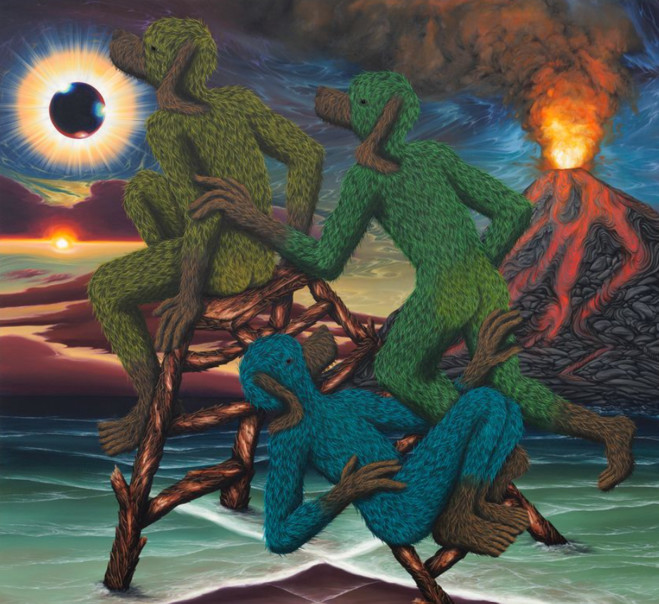
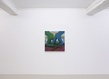
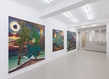
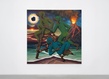
Liquid and larger than life, the energy and formal motifs of the movement Frankétienne saw capturing the “heart palpitations” of the modern world, as well as the monumental material vision of Smithson, flow into Drew Dodge’s paintings in oil on canvas. For “Earth-Pourers,” his third solo exhibition at Semiose gallery (after Earth Song in 2024 and Rainbows, Rituals, and Ruins in 2025), the New York based painter embraces the motif of the shell—present in nearly every canvas in this recently completed series. A prehistoric persistence of the spiral, the shape is a liberating and creative tool for the painted cast of Earth-Pourers, “makers, artists,” the painter explains. The welk’s winding interior provides a twisting template for his core compositional elements: entangling interspecies, roiling skies, overlapping riptides, fast flowing lava, and serpentine stretches of rope.
For Dodge, the shell is both symbol of time and memory (the past and what is known) as well as infinity (belief in the beyond). Fitting too that the shell’s iridescent, pearlescent surface mirrors the gloss of increasingly large-scale canvases.
As if inundating his earlier desert vistas, as much inspired by lonely highways of his childhood Arizona as his love for Salvador Dalí’s arid, thorn sharp expanses, Dodge floods these new works with visions of water—an evocation of mirage. Here, sand dunes become oceanic horizon lines, and snail shells replace his weathered motif, the sun-bleached cow skull.
Though, like the animal skull, which Dodge sees as a sort of musical instrument, hollowed and sonorous, the artist all appropriates the conch as a vessel for sound. As E.B. White (1899–1985) writes in his poem, “The Conch,” the vessel is a portal for soundwaves from the beyond: “Hold a baby to your ear / As you would a shell: / Sounds of centuries you hear / New centuries foretell.” A resonant howl of landscape and imagination is nearly audible in Dodge’s windswept compositions. (Though, notice how the floppy ears of the just slightly larger than life chimeras rest serene.) It’s the billowing smoke, fluttering ribbons, and clouds stretching pre-storm Cirrus that alert to coming chaos.
“Conductor of canvases,” the artist smiles when he describes his way of working, a ritual of scale, scenography, and incantation. Beginning on stretched cotton—“I need it very tight,” he explains—Dodge always paints the sky first. “It’s a fun way to start the work. The sky sets the mood—and the lighting.” Although he hasn’t yet worked in theatre or opera, refuses to call himself a musician or a dancer (even though it’s a dance he describes when he puts brush to canvas, and a dance he sees his protagonists performing), Dodge voices a stage director’s vision. He builds celestial luminosity with a large wide flat brush, creating an extremely flat and perfectly slick surface. The characters come last, rendered back to front. Then it’s a “devotional layering of oil” as he paints each hair one by one in a meditative process that flirts with disassociation. Dodge quotes Michelangelo (1475–1564), “a painter paints with his brain not with his hands,”—he, too, feels an urgency to push his superbly slick surfaces towards an illusion of matter and texture. Drawn to the bubbling musculature of Renaissance sculpture, Dodge admits admiration and obsessiveness for describing material. Working alone in his studio, listening to Derek Jarman’s Blue (1993) on loop, “I feel like I’m reaching a spiritual place,” Dodge tells me, “something greater we can all connect to.”
Gravitating towards large-scale narrative painting, Dodge aims to “fossilize a liminal moment where the fate of the scene is nebulous.” Unlike Emanuel Leutze’s triumphant Washington Crossing the Delaware (1851) or Theodore Gericault’s tragic Raft of the Medusa (1819), the viewer does not know how Dodge’s situations will resolve. In his project of world-building, he suspends his viewers in a vivid vortex of uncertainty—a rather fitting portrait of today. What will these “Earth-Pourers” produce? And will their proposals prevail?
At least one critic has connected Dodge’s canine characters to cosplay. “You are allowed to see what you see,” the artist concedes, but in fact, he clarifies, he came to this hybrid creature as a natural solution. “I didn’t want to paint myself,” he recalls. “I see figures as stand in for myself. It’s not that they’re dogs, but that they’re between animal and human.” In the words of Italian philosopher Emanuele Coccia (b. 1976), recalling Ovid’s mythical tales of transformation, the metaphysics of mutability manifests in metamorphosis. It is the death of one way of being that grants life for another. Plus, in this place of sea change, play is possible. “Because they live in a world between human and animal, there are no rules, no limits,” Dodge reveals. “Crazy is accepted and the door opens to the sensual.”
This quantum connectivity channels the thinking of another 20th century Caribbean poet, Édouard Glissant (1928–2011). Articulating the archipelago as a model for non-hierarchical cooperation between diverse bodies, Glissant’s philosophy imagines independent islands overcoming watery frontiers to act together as a cohesive entity. Eccentricity translates into force. “For me, queerness has always been something spiritual,” Dodge confides. “It is interdisciplinary and transformative, my way of understanding the connection my body has to the landscape and our wider universe.”
“The spiral is queer.”
Lillian Davies April 28, 2026
All quotes from author’s conversation with the artist, April 4, 2026.
Opening hours
Tuesday – Saturday, 11 AM – 7 PM
Other times by appointment
Venue schedule
The artist
-
Drew Dodge