 Events
Ernest T. — Devenez un artiste admiré
Exhibition
Ernest T.
Devenez un artiste admiré
Past: June 27 → July 25, 2026
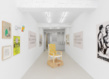
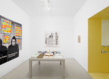
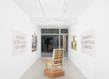
Painting is the focus of this new exhibition by Ernest T. Painting in general and that of others, and which includes: what people have to say about it, how they make a living from it and how they sell it. And even if Ernest T. categorically refuses to identify as a painter, he nevertheless uses it as a medium, going against the grain and like a true sophist, making sure he gets his point across.
Ernest T. began his artistic experiments in the 1960s with a number of humorous calendars which went on to become his Dessins français series. During the 1980s, he invented his pseudonym and began painting his Peintures nulles series [Zero Paintings], intended to be seen as the most basic level of painting. Reacting to the phenomenon of artists being considered stars, where the signature seemed to take on more importance than the work itself, Ernest T. produced paintings where his repeated signature completely covered the canvas.
“I painted my first Peinture nulle in 1986. The same year, I was invited by Claude Rutault to exhibit six of them at the Atelier Schwartz. They were hung next to a series of his Définitions / Méthodes works. Some of the texts I had previously published had quickly resulted in me being categorized as a conceptual artist (sometimes people took an interest in my work for the wrong reasons!). […] So, I wanted to get away from writing and decided I needed to do a painting to explain myself better. But which direction should I take? Monochromes were very much in vogue, but already on the way out. At the time, I was interested in arranging shapes, like puzzles. I discovered the English mathematician Roger Penrose’s tiling theory: two rhombus-shaped tiles that gave rise to one another in a non-periodic manner, by which I mean infinitely. So, I came up with this thing—which I’m still excited about—the principle of using the letter T in three colors. Previously, I signed my works “Ernest T.,” so I said to myself: that’s what I have to do! I chose three unconventional colors rather than the primaries: baby blue, bright yellow and an intense vermillion. This methodology allowed me to create canvases that were similar but never identical, given that there are an infinite number of possible arrangements for these shapes.” (1)
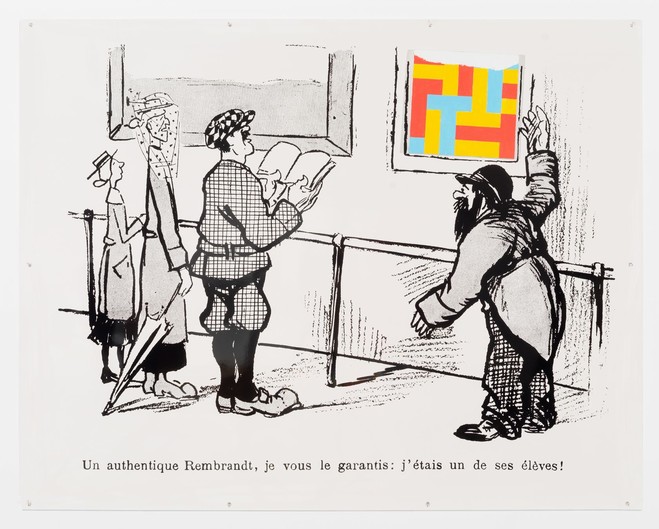
When they are not mounted as spring-loaded practical-joke contraptions or used as furniture, these Peintures nulles are incorporated into offbeat comedy sketches that poke fun at the processes of artistic legitimation and other practices related to signatures, authenticity, the hidden meanings of works, artistic trends and so on. On these found images, reproduced in large format, Ernest T. pastes his self-referential collages, which thus become the center of attention. “I created these montages for my first exhibition at Gabrielle Maubrie’s gallery in 1987. I used images from the Vermot Almanac, which I’d been collecting for a long time and which conveyed the atmosphere of an artist’s studio, and then I pasted my own paintings onto them.”
In the same vein as the Arts Incohérents and Dada, Ernest T.’s work challenges the highly codified and serious world of contemporary art. Through appropriation, image manipulation and even plagiarism, enhanced by linguistic wordplay and caricature, the artist examines the world of art from the perspective of its moral turpitude, greed and other pretentions. The greats of art history are not spared, from Picasso (Comment saloper un Picasso avec une petite déco de merde) [How to Mess Up a Picasso with a Crappy Little Decoration], Marcel Duchamp, Ready Made by Ernest T. (1987), which consists of a bill and receipt from a department store for 50 bottles—nothing is mentioned of the Porte-Bouteille but the reference is more than obvious—and even the Tachism movement: Çà ou ce que j’aurais aimé avoir fait, 2026 [That or What I Wish I Had Done] or pedantic conceptual art: Idéologie du prêt-a-jeter (en marbre), 1989, [Ideology of the Disposable (in Marble)] and Philosophie de la pacotille (en bronze), 1989 [Philosophy of Junk (in Bronze)]. The buying and selling of art is also targeted with depictions of storefronts or posters advertising the sale of artworks—sometimes boring, sometimes alluring, but always pathetic.
Jacques Sternberg, a Belgian writer and co-founder of the Panique group alongside Topor, Arrabal and Jodorowsky, wrote of Ernest T.: “His humor is always in keeping with his line: highly ironic and delivered with the utmost nonchalance.” But for the artist, humor is never gratuitous, it is an act of outright subversion: “I came to realize that humor is what best undermines deception, illusion and falsehood.” “A mad fit of laughter or the laughter of a madman” François Coadou states “is first and foremost that of the Incohérents, like that of the Situationanists, or even more so, that of Nietzsche, mocking everything and leaving nothing unscathed.”
__
1. All quotations are excerpts of the interview published in Ernest T. Face à Face François Coadou, Semiose Éditions, Paris, 2026.
-
Opening Saturday, June 27 11 AM → 8 PM
Opening hours
Tuesday – Saturday, 11 AM – 7 PM
Other times by appointment
Venue schedule
The artist
-
Ernest T.