 Events
Moffat Takadiwa, The Crown!
Exhibition
Moffat Takadiwa, The Crown!
Past: March 14 → May 16, 2026
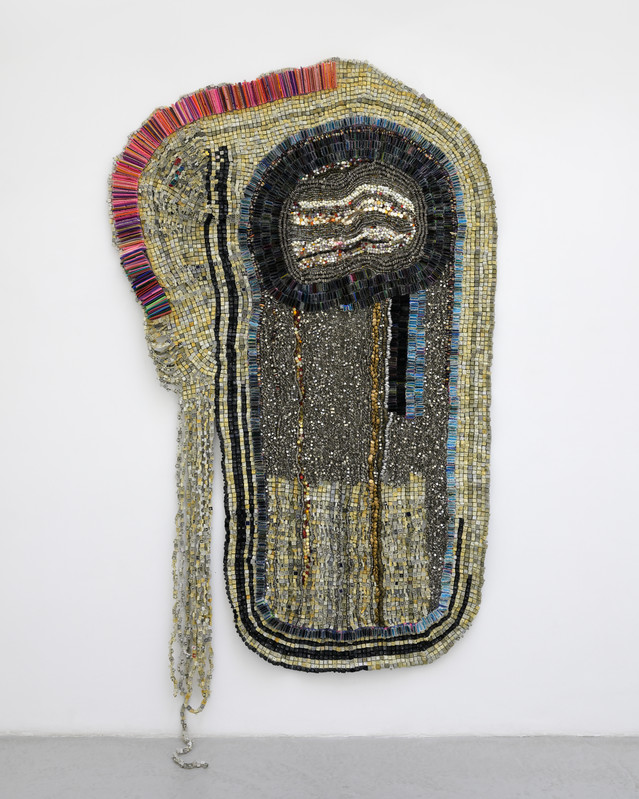
In Harare, there is a heap of bright blue keyboard keys, sorted by someone with the patience most of us can only imagine. For years, Moffat Takadiwa has been gathering these fragments from the landfills around Mbare, a neighborhood that doubles as both a recycling hub and a monument to the afterlife of mostly Western consumer goods. Each key once helped someone in London or Los Angeles dash off an email, now long forgotten. Takadiwa fits them into patterns, circular and repetitive, each arrangement held together with a kind of stubborn precision. The result is beautiful, which is where the trouble begins. If beauty could settle old scores, the art world would have solved more than it has. Takadiwa, who has spent nearly twenty years in this terrain, seems to understand that. Rearranging the materials does not erase their origins. If you have ever pressed ’delete’ and believed the problem was gone, his work offers a quiet correction. Nothing disappears; it only travels, usually to places like Mbare, where Takadiwa opened his artist-run space in what used to be a colonial beer hall.
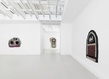
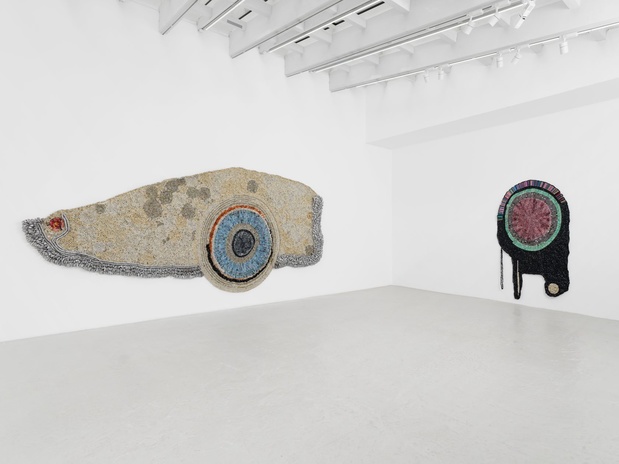
The first time I saw Takadiwa’s work live was at the latest edition of the São Paulo Biennial. Inside the massive, modernist pavilion where the exhibition took place, his tapestries seemed to breathe—dense, shimmering surfaces that kept you at arm’s length even as they drew you closer. Built with objects such as buttons, computer keyboards, and bottle caps, these were not just clever arrangements of trash but archives of longing, accumulation, and pushback. Their abundance felt both festive and elegiac, a tension that has only grown sharper in his latest presentation entitled The Crown! at Semiose gallery.
I keep returning to Mbare Art Space, the artist-run project Takadiwa started in Harare, inside a former colonial beer hall. It is easy to file this as background, but it is really the heart of his work. The collective labor at Mbare—young artists working with Takadiwa, turning Western castoffs into something new—mirrors the Korekore weaving that shapes his art. Here, weaving is not just a technique but a language, a means of collective thinking. It matters because it refutes the old myth of the solitary genius, insisting instead that meaning is built together, slowly, gesture by gesture.
The Crown! pushes Takadiwa’s ongoing project further, reclaiming the leftover traces of everyday things and turning them into what you might call post-industrial textiles. These are not objects of comfort. They carry the tensions of Africa’s post-colonial afterlife: the politics of black hair, the hunger for small vanities, the choreography of conspicuous consumption. Afro combs, which appear throughout the show, serve as archives of social, political, and spiritual history, rooted in African traditions and the colonial self-fashioning they forced. Once tools for grooming and ritual, these combs now bear the weight of resistance and pride in Black political life.
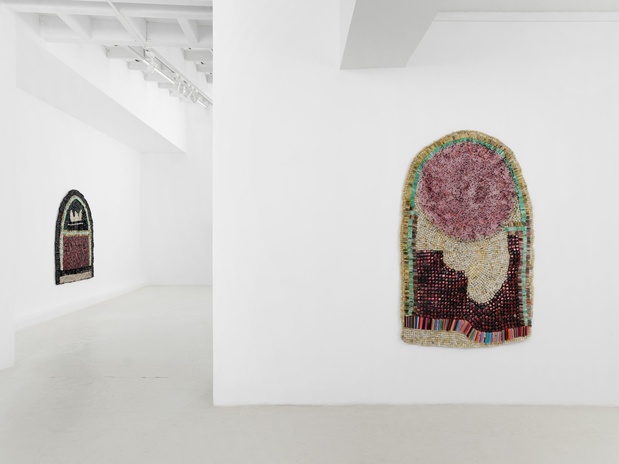
Throughout the exhibition, crowns built from keyboard keys, bottle caps, and combs stand for authority and power, but are always rooted in Black experience. In Takadiwa’s hands, hair becomes a way to shape the self and push back, tangled up with the gendered politics of Black grooming and the colonial histories that still shape Zimbabwe’s sense of beauty. Western portraiture’s single, commanding gaze is pointedly absent. Instead, circular forms and masks suggest wholeness and a shared identity. The objects have become guardians, their faces spiritual, in step with African cosmology and the influence of ancestors.
Takadiwa’s work moves on several levels at once. Circular forms and masks hint at wholeness and a sense of the collective, acting as guardians that echo African cosmology and ancestral power. Hair and keyboard keys—one organic and charged with meaning, the other industrial and anonymous—are set side by side, pointing out the way identity gets tangled up with global manufacturing. These materials, pulled from Harare’s waste, end up in galleries, priced for Western buyers. This is not a failure of the work, but maybe its most truthful aspect.
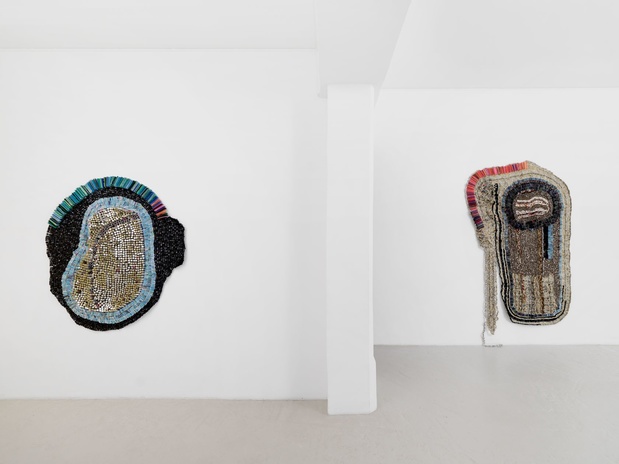
What lingers most in The Crown! is its stubborn hope, even as it tallies up the wreckage left behind by extractivism. At its core, this is a show about how objects move from the simple to the complex, from the discarded to the charged. Takadiwa’s work makes room for critique, but also suggests that change is possible—if not through grand gestures, then through shared effort, spiritual grounding, and the slow work of refusal.
His works show that you can rebuild worn-out structures from the ground up, using the very scraps left behind by extractivism. The beer hall that once enforced colonial order now shelters a community of artists, busy with the work of repair. This is not a metaphor. It is the reality that shapes Takadiwa’s crowned figures—not as dreams of some lost pre-colonial past, but as composites, pieced together from the fallout of a once-promising globalization project, insisting on their own way of being. Whether the westernized art world can meet that insistence or only admire it from a safe distance remains an open question.
Opening hours
Tuesday – Saturday, 11 AM – 7 PM
Other times by appointment
