 Events
Roy Köhnke — All as Usual, Bright and Beautiful
Exhibition
Roy Köhnke
All as Usual, Bright and Beautiful
Past: January 22 → March 7, 2026
We were impressed by the precision of Roy Köhnke’s works presented at Crédac in 2025, as well as by their spatial installation. Scales varied, yet rigor and a certain flexibility in improvisation consistently established a sense of complicity. The space we are offering Roy at the gallery provides an opportunity to extend the experience of his relationship to drawing, which is very directly connected to bodies and to the personal and intimate messages they carry into public space, as a gesture of reversal. The storyboards of the leather jackets that Roy customizes narrate the effort of reconstructing the entire logic of bonds that are vital, and the hope that things might pass—as nothing ever does in life, except life itself. IA & CB
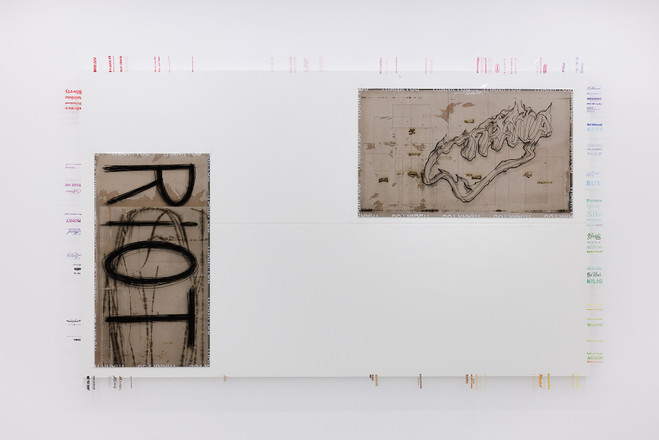
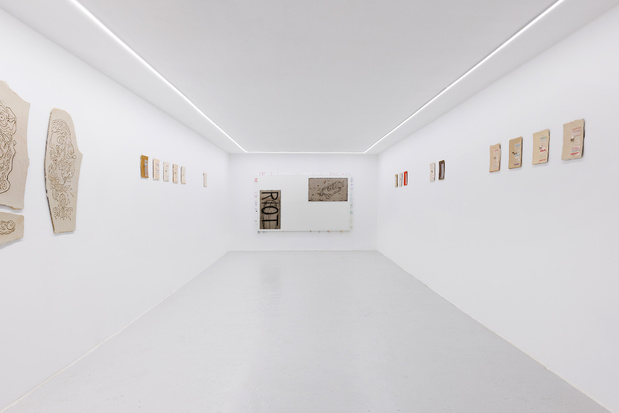
IA: There is something fragile and tender in what you have chosen to show “dans la chambre d’ami·es” [in the guest room] at Marcelle Alix, Roy. While these new works connect with the drawings we discovered at Crédac at the beginning of last year, here you have engraved cardboard or handmade paper that you produce by assembling different kinds of sheets, like skins of matching thicknesses, on which tattoos appear (PDA (Public Display of Affection) Jacket #2_+2LARM4U (paper skin version), Working Table, TRANS_ RIOT_).
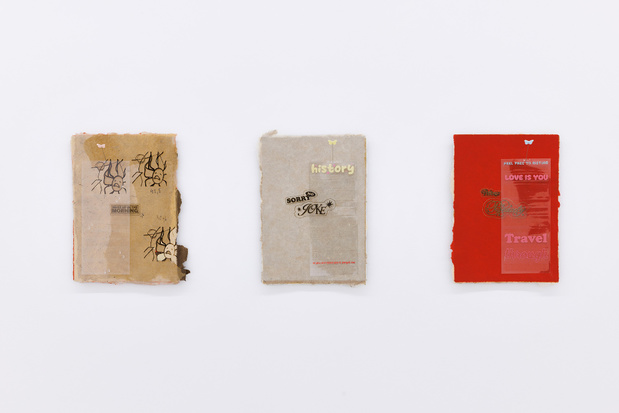
To these expressions of extreme affective intensity are added the simple messages of commercially produced sticker sheets found in Beijing, where you were in residence over the past two months (Chanting Stickers Series). These sheets are redacted so that only a few words remain visible and are “planted” into the paper with a pin adorned with a butterfly.
At the gallery, we are attentive to the gestures that accompany the making of works, and if I evoke tenderness, it is because I see in these pieces a form of care that reminds me both of the attention Gyan Panchal gives to the logic of found materials in his sculptural practice, and of the infinite affection Donna Gottschalk brings to the people she loves to photograph. I do not know whether you are familiar enough with these two artists to grasp what I am trying to say, and perhaps it simply comes down to the idea of fairness. As an artist, how is one fair—with materials, with the participants in a work?
RK: It is a difficult question, but I think I can find the answer in the intimate relationship I develop with materials. It is through contact with them, in a form of prolonged closeness, that my gestures become attuned. I feel a sense of fairness when I manage to make them vibrate and when they give form to the emotions that pass through me, and to achieve this I work primarily in thickness.
My projects are composed of multiple “layers” that can be traversed: material layers, but also layers of meaning and of stories. For example, the Chanting Stickers resemble a series of pages that in turn refer to notebook or sketchbook pages, but also to marked bodies. Each page is made by superimposing several layers of paper. The combination of their different characteristics—colors, transparencies, textures—allows me to achieve depth and complexity in the material.
But the “layers” do not stop there, because each page also carries a short text composed through the removal and rearrangement of words from a sticker sheet, as well as others engraved into its thickness. Because of the gesture of placing rather than gluing, the composition of the pages is not immutable and remains open to the possibility of evolution and transformation.
Some texts function like short stories in which the words themselves are personified—Miracle, Future, Miss Liberty, Anonymous. Others are more directly addressed. Words encourage and comfort one another, but sometimes they also withdraw to make room for tears. Yet whether they are missing or faltering, words are all carried here directly on the skin, like marks of love and care that are archived as close as possible to bodies and encourage us to form bonds, to be bonds, to be Trans—that is, as the CNRTL defines it so well, to be a formative element.
CB: Say something… Night falls over these three suspension points, just as solitude and waiting weigh upon the feeling of love when it comes to an abrupt end. There is also, in the wake of an emotional eclipse, real night enveloping the person we see walking away in public space, a luminous butterfly reflected on their oversized T-shirt.
If this screenshot was the starting point of your artistic process, Roy, the image later found its place between us by serving as the cover of the portfolio you regularly updated. You seem to recognize yourself in the euphoric idea of recomposing, with the risk of great porosity between flesh and materials.
This image acts as the statement of an exhibition that rests in part on intimate narratives freely introduced—through the customization of the iconic leather biker jacket—into public space. Your works desire an expanded life, multiplying attentive addresses to transgender people.
Like fragments of discourse searching for moments of intensity, you play with the candor of stickers, allow yourself to be affected by their gratuitous encouragements, and find a bold space of speech within a residency context where censorship is inflexible and omnipresent. As you say, you “thicken,” then allow things to mature and press until provoking a response from the organism of beings confronted with a situation—like those cartoonish fingers pressing on an eye so that it may cry, extinguish the fire, and save the flower.
Is it getting worse and worse? Do your works cry plastic tears for all of us? The patterns adorning your jackets ignite a fire behind which you see virtue rather than destruction. And for this fire to become real, you rub up against words that no sticker offers you—words already thick, like “TRANS” and “RIOT,” which call for the uprising of a community.
You say you were able to write the word “RIOT” because the artist Christopher Wool did it before you in a painting that reached a record sale price. You smile as you evoke a world that keeps turning over and over. Just like Riot Flower, which you cite as an example to open up meaning, you sign the image of number, united through diversity.
Roy Köhnke (b. 1990, France) is an artist living and working in Paris. Sculpture forms the core of his practice, which extends into drawing, writing, and video. Drawing on queer studies and science fiction, Köhnke seeks to propose alternatives to dominant narratives that constrain bodies and lived experiences. After studying at the École des Beaux-Arts in Nantes and Paris, his work has been presented in several solo exhibitions, including Fleur Feu, Crédac, Ivry (2025); La Belle sucette, Le Grand Café, Saint-Nazaire; It Is Stronger Than I Thought, ADAGP, Paris (2024); and Love Bugs as a Spit on Dry Land, SHED, Rouen (2023). His work has also been shown in group exhibitions such as Publiek Park, Plantenium Meise, Brussels; Éprouver l’inconnu, MO.CO, Montpellier (2025); F®ictions of Intimacy, CALM, Lausanne; TRANSGALACTIQUE*, La Gaîté Lyrique (2024); and Antéfutur, CAPC Bordeaux (2023). His project Magnetic Tendencies was recently supported by the Fondation des Artistes (2025). His work is part of the collections of FRAC Normandie Caen, CAPC Bordeaux, FRAC Nouvelle-Aquitaine, Lafayette Anticipations, and FRAC Artothèque Nouvelle-Aquitaine Limoges.
Opening hours
Tuesday – Saturday, 11 AM – 7 PM
Other times by appointment