 Events
Stefan Rinck — Paddling Between Two Realities
Exhibition
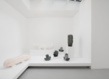
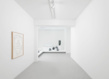
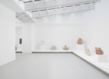
Stefan Rinck
Paddling Between Two Realities
Past: January 10 → March 7, 2026
At the heart of Stefan Rinck’s artistic practice there lies a double paradox that stems from the very form of his works. Heirs to a vast symbolic heritage, they appear to bear the promise of a ritualistic form of existence and destiny. Yet, the vitality of the artist’s oeuvre resides precisely in the tension engendered by the subversion of these expectations, opening up a space for reflection on the persistence of symbolic representations.
The array of characters draws on the mythology of guardian entities and zoomorphic deities traditionally associated with sacred edifices and which have existed throughout human culture. From Mesopotamia to ancient Egypt, Mesoamerica to Western Gothic cathedrals, religious architecture has almost always featured sculptures having specific functions on facades, on thresholds or inside the ceremonial spaces themselves. These representations each have particular roles: that of guardians (an apotropaic purpose intended to ward off evil), the depiction of deities, the statement of political power, the telling of a collective, historical narrative, or even as metaphors for virtues that should be aspired to. Stefan Rinck evolves within this vast repertoire with an accomplished freedom. With its totems, monumental statues, ritualized elements of furniture, smaller guardian figures and caricatures of morality, his oeuvre encompasses most sculptural typologies. In one sense, Stefan Rinck operates in a “Warburgian” manner, composing what might be understood as an additional plate of the Mnemosyne Atlas, focused on the sculptural vocabulary of devotion. He thus constantly intermingles eras and styles, up to and including the most contemporary references to forms derived from non-religious devotion, such as Labubu figurines, dinosaur action-toys and video characters that occupy our screens as everyday icons. At first glance, these works, drawing on an immense sacred heritage, suggest that they may not only represent but also embody a relationship to the sacred.
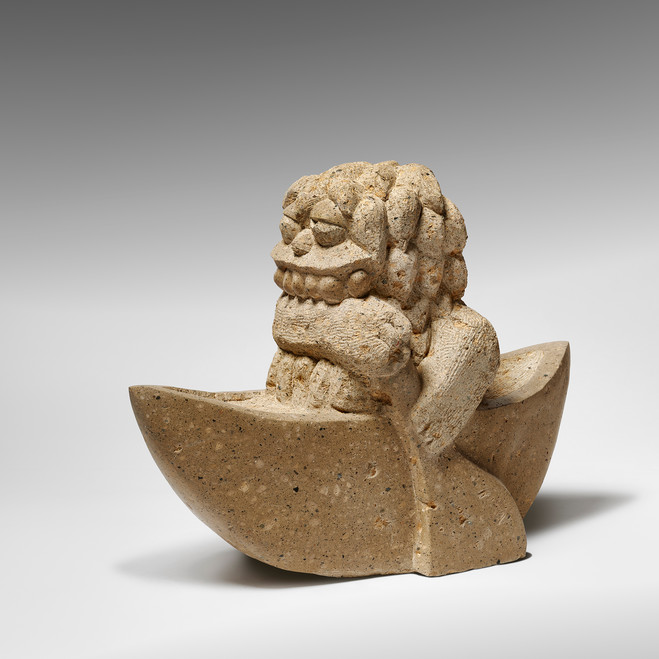
This is where the first of the paradoxes arises. The sculptures to which Stefan Rinck’s work refers, are, in their original contextual settings, inextricably linked with religious sites. They exist in specific locations—in most cases a building—which provides them with their basic function. Their meaning is therefore assigned by the spaces they inhabit. Rinck’s sculptures however, are free from any spatial restriction; they do not, a priori, require a prescribed architectural context. Unlike the objects they are inspired by, they are even destined to occupy a number of spaces during their existence: the artist’s studio, galleries, museums, collector’s homes and gardens. Yet, within themselves they seem to harbor the memory of a threshold, a façade or a niche, without ever having been able to inhabit these spaces. The tension between his reference to deeply rooted forms and the manner in which he deliberately decontextualizes them is one of the key driving forces behind Stefan Rinck’s work. This is particularly apparent in the exhibition at Semiose, where the motif of the boat and the act of crossing clearly evoke the idea of passage.
The second paradox touches on the question of aura. Stefan Rinck’s sculptures seem to be imbued with a particularly singular presence. Their frequently zoomorphic appearance undoubtedly has much to do with this, as it suggests an interior life that surpasses their natural materiality. This transcendence is also in part due to the artist’s practice of direct stone carving, which lends these sculptures both symbolic continuity and historical depth, as they evoke the imagery mentioned above. Taken together, these two elements contribute to charging the works with a certain aura, as described by Walter Benjamin as a relationship to the “distant,” often supported by a sacred subtext. However, even if Stefan Rinck’s figures seem inhabited, they also seem to be aware of their own lack of any true ritual function. In this respect, they seem to be endowed with a certain self-reflexivity: they seem bored, seeking some form of distraction or imitating the gestures of an absent ritual. They are rowing against the current, engaged in a race with absurd overtones. Disguises and costumes also contribute to this feeling: these characters seem to be waiting for an assignment that is never attributed, taking on the role of divinities to the point of absurdity. Such is the case with Croc Pope or Castle Maid, whose deliberately inappropriate costumes contribute to the mischievous tone of the exhibition. One could thus describe Stefan Rinck’s practice as an aesthetic of désœuvrement, where his characters embody the memory of a sacred function and the impossibility of fulfilling it.
Yet, while Stefan Rinck’s artistic practice might seem paradoxical, it draws its unquestionable vitality precisely from these shifts, refocusing our attention on collective myths as subject matter for study in their own right. Numerous thinkers and philosophers from Cornelius Castoriadis, Carl Gustav Jung and Georges Bataille have postulated a return to imagination, to archetypes and to myths, notably in times of social crisis. To capture the essence of the transition we are currently experiencing, Federico Campagna has come up with a particularly useful frame of reference in his book Technic and Magic, The Reconstruction of Reality (2018). He suggests we are witnessing the decline of the mode of reality associated with techno-capitalist rationality, which has become incapable of generating meaning and that it is being replaced by a new regime based on magic, which is to be understood as an ontology of indeterminacy, imagination and the ineffable. Stefan Rinck’s characters exemplify this swing: firstly, the loss of reference points in our societies, which is encapsulated in the spatial paradox of the works, and secondly the loss of collective meaning, suggested by their aimlessness and biting humor. Thus, what remains is nothing more than the formal image of a symbol or ritual, representing both the figurative container and the abstract content of the work. Coming back to the motif of the boat, it takes no great leap of imagination to think of the symbolic heritage of the river as a place of passage between two states, or in this specific case, between two realms of reality. This hypothesis is certainly confirmed by the two characters wearing “plague healer” masks, who seem to be fleeing from a world of morbidity in the hope of finding somewhere more pleasant at the end of their travels. Stefan Rinck’s sculptures seem to me to be talismans, whose effectiveness is no longer guaranteed but which we hope might transform our relationship with the world as well as with others simply through their very presence.
Camille Bréchignac
(translation: Chris Atkinson)
-
Opening Friday, January 10, 2025
Opening hours
Tuesday – Saturday, 11 AM – 7 PM
Other times by appointment