 Events
Ymane Chabi-Gara — Even E.T. scared me
Exhibition
Ymane Chabi-Gara
Even E.T. scared me
Past: June 10 → July 25, 2026
 Ymane Chabi-Gara — Galerie Mennour
At Galerie Mennour, Ymane Chabi-Gara presents an exhibition that feels at once restless and dreamlike. Images collide and intertwin...
Critique
Ymane Chabi-Gara — Galerie Mennour
At Galerie Mennour, Ymane Chabi-Gara presents an exhibition that feels at once restless and dreamlike. Images collide and intertwin...
Critique
The highest level of anxiety sums up the feelings Ymane Chabi-Gara expresses in her paintings. Obsessively she represents enduring modes of confinement, whether voluntary or not. For her first paintings, she immersed herself in the world of hikikomori, those young Japanese people who live in their rooms, completely withdrawn from society. Their daily life is beset by various forms of social anxiety, filled with digital hyper-connection and haunted by fear of failure. Some time after, her practice opened to lighter images of landscapes prompting her pictorial technique to evolve. In a new way in her practice, she began working in wash drawing in extremely structured compositions involving the use of Sellotape. Later on, the darkness of the contemporary world and of the human spirit resurfaced in her painting. In this exhibition, she confronts herself with another confinement, that of the family circle.
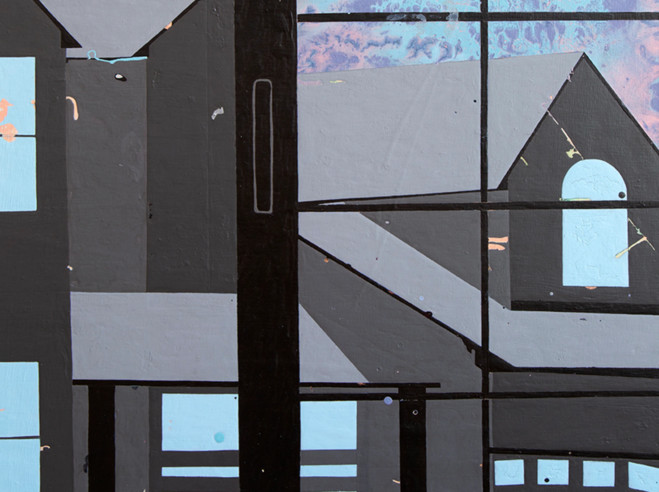
“Even E.T. scared me” is a sentence pronounced by a character in the film Mysterious Skin (2004) by Gregg Araki. Upset by unexplained wounds, beset by nightmares and in the grip of fainting fits, a child thinks he remembers having been abducted by aliens: it is the image of a baseball coach who abused him in the past, blotted out of his mind. In Coaches Room, the room of the latter appears in its disarming banality. Two slightly worn armchairs, lamps on a chimney, drawn paper planes in frames, a whole array of toys for children and teens: baseball bats, models of rockets, arcade games… But the horror took place in that setting, imperceptibly. It is a depiction of the accident, Ymane Chabi-Gara seemingly says: the accident in the narrative as in the painting. On the wooden panels she used to compose that triptych, as is her habit, she kept blank traces on a light background on the wall. Like bullet marks. The reliefs made with Sellotape, which reappear under the layers of the thick gesso she applies for her preparations, outline ghosts in the composition.
Brian’s Room is also immersed in the oppressive atmosphere of that confined world. Lying on a bed, a young man appears to be writing. The light suspended from the ceiling resembles a galaxy of colourful planets. We can only see the back of his head. Ymane Chabi-Gara rarely represents faces. At the very most the figures have the white eyes of statues. With that young man, the fabric his clothes are made of gives us a visual opening. In the painting. For the last few years, Ymane Chabi-Gara has been working in small format, called One Day Paintings. Those are the sketchbooks she doesn’t have. The detail of a grid, an abstract motif, a piece of fabric, part of a landscape… She experiments and re-uses that research in her large format paintings. Brian’s jumper comes directly from one of them.
One of the most enigmatic paintings is that of an impossible architecture, an illusion of construction one catches a glimpse of on the horizon, from a window. It also looks like children’s toy cubes or the landscape of a video game. The irregularities in the land and the changeability of the clouds contrast with the geometrical aspects of the building. The atmosphere of that painting is borrowed from the film Streamside Day (2003) by Pierre Huyghe. On a full moon night, a family moves in a housing estate, a suburban one left unfinished. The celebration of their arrival is filmed with a hand-held camera, the image is streaked, there’s the sound of a guitar. The children are wearing rabbit masks. Ymane Chabi-Gara has represented one of those fancy dresses in an origami. On the side, she painted a selection of her One Day Paintings, a way for her to keep those intimate works in her painting.
Music and fantasy films are the bases of her universe. Several paintings are inspired by Yorgos Lanthimos’ film Dogtooth (2009). Three children having become young adults, live with their parents in the confinement of a house thinking that going beyond the fence would be tantamount to dying. They believe the planes flying in the sky are toys, like those scattered in their garden. In their private family language, they say one word for another. The word telephone means salt, the sea designates a sofa, and grand-father, a hi-fi system. Young Sister’s room is bathed in an orange-tinted atmosphere. A window gives onto the outside. In these paintings, there is the call of the real world, expressed with effects of transparency. Someone is hoovering as if they could clean minds, but all we see is the elegant pipe. The character has fainted. The small colourful painting hanging at the edge of that opening is inspired by Bob Ross, a presenter from the 1970s who used to give painting classes on live television, a representation of the pleasure and sensuality of colour.
Origami paper planes fly in the room, some have fallen on a table. Those delicate foldings are visible in all the exhibition’s paintings. Ymane Chabi-Gara has developed a passion for that Japanese amateur practice. Those objects, images of patience, rigour and concentration are made with ordinary materials but are turned into small treasures. They impart an atmosphere of simplicity and elegance. But the experienced eye will identify instruments of war in those flying machines. The Internet is awash with tutorials to make a whole arsenal of them. Fragile bombers made of paper, they are an image of resilience facing the disasters of the world.
Anaël Pigeat
47, rue Saint-André des arts
6, rue du Pont de Lodi
75006 Paris
T. 01 56 24 03 63 — F. 01 40 46 80 20
Opening hours
Tuesday – Saturday, 11 AM – 7 PM
The artist
-
Ymane Chabi Gara