 Events
Szabolcs Bozó — Antidote
Exhibition
Szabolcs Bozó
Antidote
Past: May 23 → June 20, 2026
“What is art for, what can it do, what’s the point of it all?” This was the opening sentence of the exhibition text written by Scott Indrisek for Szabolcs Bozó’s first solo exhibition at Semiose Gallery in June 2020 during the COVID pandemic, entitled Big Bang. Six years later, in a world beset by turmoil and war and besieged by social media, disinformation and the omnipresence of AI, the Hungarian-British artist based in London is back at the gallery with a completely new body of work, which once again feels like “an antidote to this daily thrum of anxiety” (Indrisek).
Since his last show, Szabolcs Bozó has continued to fashion his own universe, populated by the descendants of a long heritage of Hungarian animation, which has evolved from traditional folklore into a complex, psychologically driven iconography. Working primarily with paper and pen, he treats his drawings as mental notes—a visual journal reflecting on the state of the world around him. With humanity at what increasingly seems to be a historic juncture, his imagery has become more pertinent than ever. Yet, almost downplaying the gravity and context of his new works, he states, “I wouldn’t exactly describe them as an attempt to escape reality; living in a big city, one is constantly aware of it. However, whenever I get the chance, I try to paint things that look hopeful rather than depressing.”
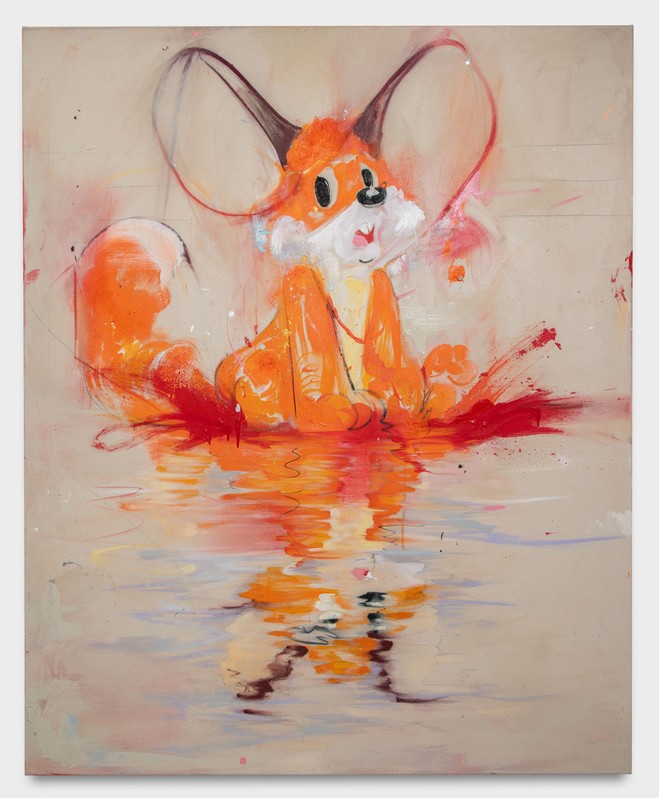
Szabolcs Bozó deliberately preserves the underlying flaws and imperfections that remain visible beneath what, at first glance, appear to be straightforward portraits of cheerful characters. His animated application of paint and occasional use of impasto engenders seemingly cute images, while still exposing their darker side. This is the principal idea behind the sometimes distorted or blurred reflections and brings to mind certain similarities to how we are inclined to perceive our online or social media selves. When doom-scrolling, we are rarely provided with the complete context of an event and our off-the-cuff impressions can easily play tricks on us. Suggesting the idea of multiple, co-existing selves, Szabolcs Bozó’s protagonists borrow features from one another and, on occasion blend into chaotic, absurd clusters of traits, colors and gestures. Whenever he addresses major issues like global mass destruction or knife crime, the artist seems inclined to react by assembling an army of animal superheroes to protect us.
This anthropomorphic approach lends his work a fable-like quality. Fables constitute a significant part of storytelling across the world—from the Panchatantra animal tales of India to the African oral tradition of trickster figures—and Szabolcs Bozó’s native Hungary has a particularly rich pictorial narrative tradition. Closely connected to folklore, these tales offer lessons about survival and shrewdness, sometimes serving as social commentary and, in particular, reflecting the socio-political dynamics of the 20th century. In a similar way, Szabolcs Bozó uses these allegories to reflect on life, but unlike traditional fables that are structured and ordered, his paintings are “noisy,” full of quirky gestural elements and often convey a sense of movement. They mirror the colorful, frantic, and often absurd side of the human subconscious—the messy, unscripted experience of being alive. This extemporaneous aspect has become an important element of the artist’s practice, making intuitive mark-making a dominant part of the way he expresses himself.
While at first glance Szabolcs Bozó’s images might appear to resemble storyboard frames from Hanna-Barbera or Disney cartoons, they in fact have more in common with Cy Twombly’s scribbles and gestures, Jackson Pollock’s splatter paintings or William de Kooning’s layered canvasses. Reflecting the artist’s high regard for the authenticity and immediacy of direct mark-making, Szabolcs Bozó’s most recent body of work is entirely focused on spontaneous brushstrokes, energetic gestures and exhilarating freshness. Capturing fleeting instants of inspiration and evoking the act of writing by hand, his gestural approach to painting challenges the idea of what a “finished” painting should look like. Deliberately leaving sections of raw canvas visible and certain brushstrokes “unfinished,” Szabolcs Bozó’s new “painterly drawings” ascribe greater value to gut feelings, immediacy and the creative process itself, rather than a polished final product. In revealing the creative journey, decisions, mistakes, and physical movements, his work becomes a channel for communication between the artist and the viewer. In doing so, it is able to explore more personal, profound subjects and is never limited by the logic of language or common sense. So, rather than immersing oneself in the scene, one can almost experience the painting being constructed before one’s eyes and thus receive an immediate “antidote” to the depressing reality taking place outside the canvas.
-
Opening Saturday, May 23 11 AM → 8 PM
Opening hours
Tuesday – Saturday, 11 AM – 7 PM
Other times by appointment