Ashley Hans Scheirl — Loevenbruck, Paris
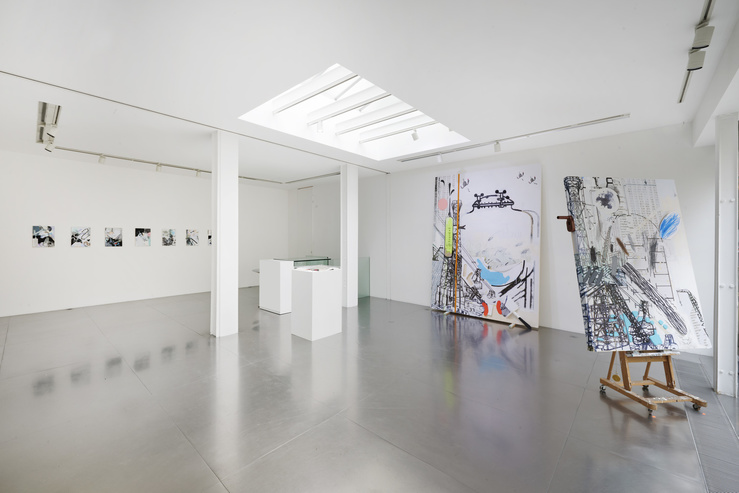
At the Loevenbruck Gallery, Ashley Hans Scheirl reinvents his pictorial practice by exploring the possibilities of wood as a support for his ever-complex and exhilarating paintings. Through increasingly concrete layers, he composes the visual prolegomena of an elliptical thought process. This shift in support entails a transformation of the very status of painting, emancipating it from its representational function to make it a space of construction and assemblage. The surface no longer constrains forms; it welcomes them. In this way, a continuity emerges where painting, sculpture, collage, and object mutually influence one another.
Ashley Hans Scheirl — Petrol M*other Paris @ Loevenbruck Gallery from October 23 to December 5. Learn more By intertwining all codes and meanings in “pictorial units” that unleash the detritus, offspring, and sometimes even erections of capitalist industry—imbued with the grotesque, bawdy incongruity, radical fury, or gleeful absurdity—Ashley Hans Scheirl reveals, through this new series, a radical reinvention of his own radicalism. Cast aside the strange beauty and the flattery of the bizarre, they give way to a festival of tensions that abandon unstable imbalances with dreamlike, surrealist overtones to rediscover a literal sense of surrealism, where the oversized degree of reality floods the representation to form a frozen mass of meaning. The complex rubs shoulders with the rough draft, while the sum of the disturbances of its raw material—the very one that fuels our society, oil—is resolved in the tip of a needle that has already begun to inject its improbable solution. The organic and the industrial are found in the manifestations of the same circulation: that of materials, bodies and the powers that transform them, exploit them and make them available.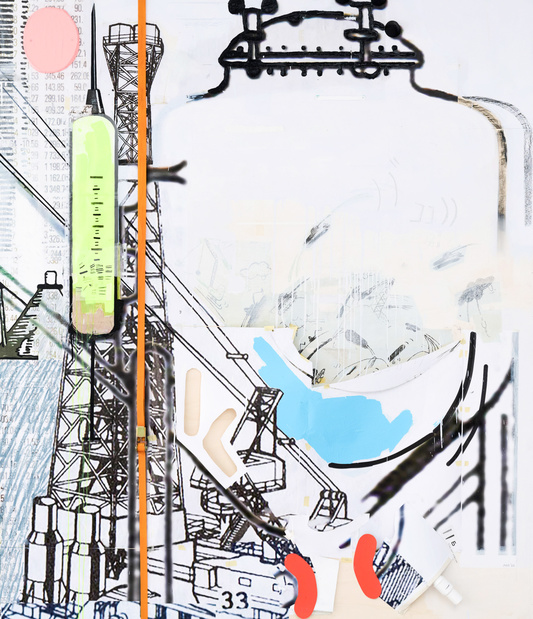
Domination, industry, dependence, and the imposition of force still form the bedrock of his raw inventions, which combine these issues into organic, matrix-like machines where it becomes unclear whether our societies or these give birth to the other. Certain motifs in his work, however, recur, creating markers that remind us where we are. The question of gender, more crucial than ever in this transition from a painter of the suppleness of canvas to the rigidity of wood, nonetheless prompts a fresh perspective on the very act of pictorial composition. The pre-printed illustrations from books on display possess the banal hardness of everyday objects, akin to antiquated signposts, which nonetheless enhance the frontality and horizontality of the composition.
The external elements, now simply deposited, no longer adorn the support by conforming to its plasticity: they must now be affixed, glued, and screwed in place. The organic outgrowths merge with the functional dimension of the juxtaposed forms. This is paradigmatically the case with the “handles” grafted onto the supports, making the painting portable, manageable, and almost transforming it into an object. This gesture is not insignificant: it shifts the artwork from a purely frontal gaze to a physical, potentially manipulable relationship with the viewer.
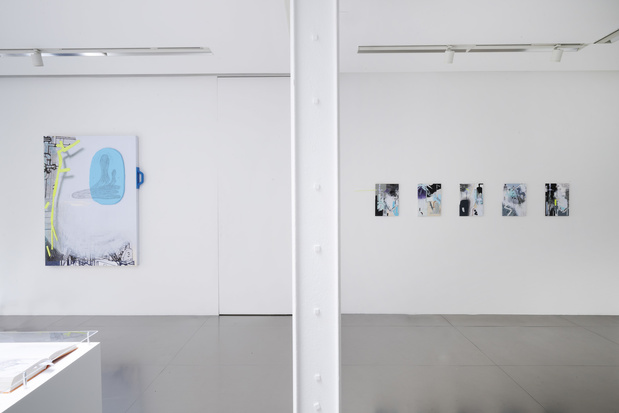
An object of resistance and struggle far more than mere ornament, the vividness of the contrasts, the unstoppable interplay of fullness and emptiness in these dripping, encapsulated, clouded, and inseminated industrial landscapes, only flatter perception in order to better challenge its limits. The aim is to make the encounter an accident, a crash of thoughts that the artist carefully avoids controlling or attempting to tame. Everything here hinges on the viewer and their perception; the artist names, asserts, exhibits, and reveals, in a deliberate transparency, a kaleidoscope capable of dismantling genres through its tangible, material will not to order, impose, or explain.
The question of genre, which formalized this shift from canvas to panel, reveals in action the essential scope of a theme in the very perception of forms. Struggle and imposition become, through the symbolic codes of the pieces in a terrible game, the site of a representation of a world in crisis, its recomposition, and its ceaseless reinvention. It is a terrain in which Ashley Hans Scheirl manages, for the duration of each of his compositions, to infect, in order to better combat, the inevitability of fate.