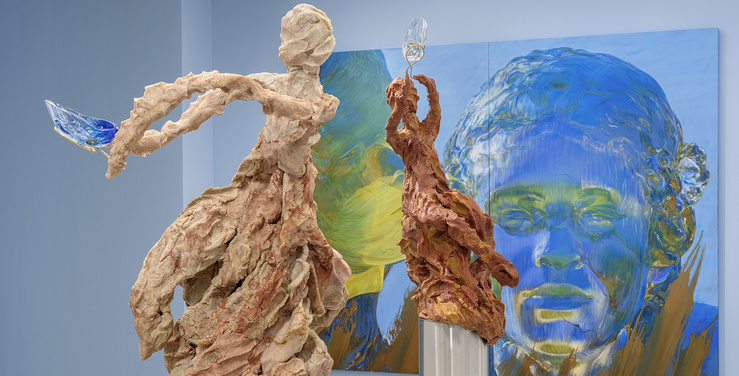
Virginie Ittah — Galerie Poggi
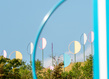
Through an imaginary world and an aesthetic of rare singularity, drawing on mythology, organic science fiction, heroic fantasy and the fantastic, and unfolding within a chromatic palette that is at once soft and marked by sharp contrasts, Virginie Ittah presents in her first monographic exhibition at Galerie Poggi a trajectory conceived as a total proposition whose ambition and success match the emotion it evokes.
Previously active within the artistic duo Ittah Yoda, known for its hybridization of natural elements within reinvented ecosystems, and initially trained as a sculptor, the artist combines technique, invention and craftsmanship to conceive a spectacle of sensibility in which the liquid becomes the essential marker of traces that are necessarily shifting. Boundless therefore, and without borders, Ittah’s exhibition is placed under the aegis of the “oceanic feeling,” that perception of the essential unity of one’s being with the universe (and, consequently, the very questioning of the self and its expectations) theorized by Freud. Born from a fascinating discussion with Romain Rolland, engaging Eastern spiritual thought as much as the liberation, through the understanding of one’s own infinity, proposed by Spinoza, this concept carries within itself the infinite polyphony of its meanings as well as the many paths through which it may be reached, through the arts, thought, music and poetry.
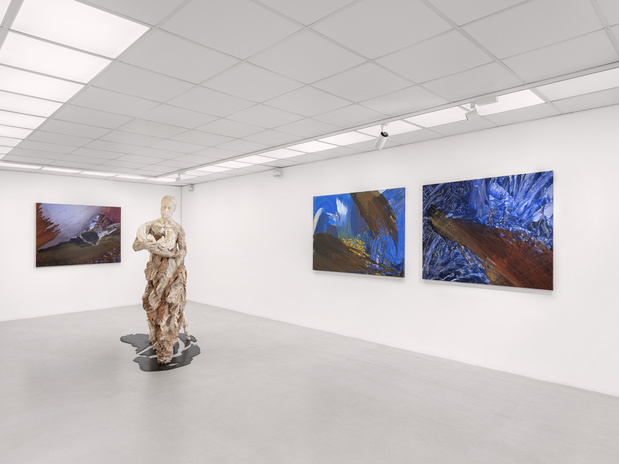
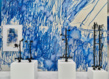
A polyphony that here turns into a polysémy made literal, referring us to the porosity and transparency of boundaries that enclose, within the same singular disturbance, the affirmation of all singularities. It takes shape in the concrete experience each work within the exhibition offers. Sculptures, paintings, musical composition and nuances of fragrance free themselves from their own unity in order to infuse one another. Color excites the sense of smell, the cavities of the sculptures resonate with notes that pass through them, and the trace laid upon a surface bears the incision legible within the material.
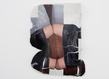
From the outset, the human faces that confront us do more than simply allow light to pass through them. Invented by another intelligence than that of the artist alone, composed among other things of modeled faces drawn from antique statues, they allow millions of others to coexist without truly being any of them. The portrait of “no one,” negative and yet generic, creative in the way it abolishes lines. Likewise, her sculptures, offering the body to every imaginary possibility, and working against the subtractive discrimination usually required for formalization, become incremental totems.
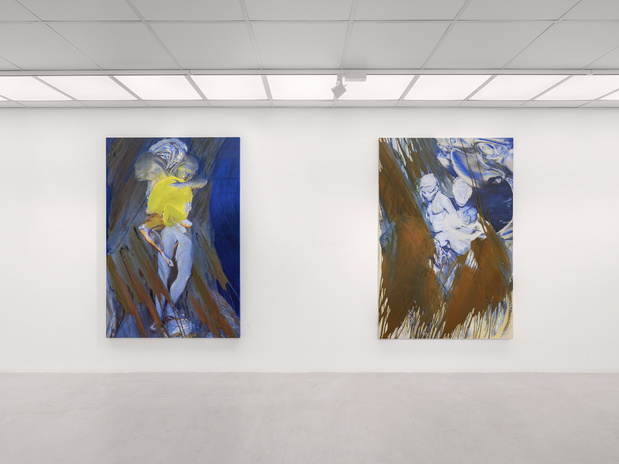
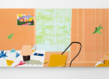
Through both subject and medium, painting absorbs itself into technology, immerses itself in technique and then absorbs them in turn, dissolving them within a whirlpool of intensities where brushed masses extend into the kneaded bodies of the sculptures that face them. They become receptacles of gestures which, concealing their beginnings, never find an end. On the ground, their liquid shadows coagulate, while in their hands floats a chalice that calls upon another sense, smell.
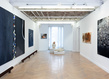
The very sense that, from the moment one enters the exhibition, literally immerses us in the act of creation. Just like the soundtrack, also created through the intervention of another, the environment becomes an active part of the exhibition. This becomes most evident when the artist, like a conductor, takes hold of it and conceives the experience beyond the limits of individual judgment. Art is a matter of sensation, not of name. And if technique merges so completely with technology, it is because the gesture remains, beyond the signature, beyond the sign.
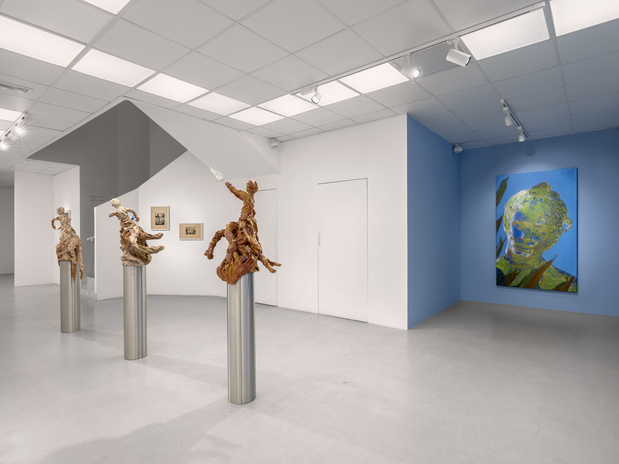
Yet the exhibition is also about progression, and the trace resolves itself, as one moves deeper into the space, into a movement of increasing amplitude. Forms liquefy, reference points expand, mythology emerges where technology first seemed to reign, marking the dissolution of boundaries. One appears to accompany the other. Matter becomes fluid, images become charged with archetypes, and the whole composes a spectacular, almost ritual ascent toward an apotheosis where dance leads to trance, the encouter to soome kind of fusion. The body exceeds the human, and painting reveals itself as close as possible to each of its traces.
For it is not only about water. The feeling is oceanic because, beyond its immensity, it connects. It connects lands, it connects what lives and grows upon them, what thinks there and what becomes visible there. The oceanic feeling is the belonging to a whole that belongs to no one.
Virginie Ittah, Oceanic Feeling, 02.06 — 03.28, 2026, Galerie Poggi, Paris, 135, Rue Saint-Martin, 75004 Paris — Tuesday to Saturday, 11am — 7pm