Winnie Mo Rielly — Maison européenne de la photographie, Paris
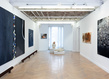
The work of Winnie Mo Rielly (born 1993) explores the points of contact between the body, the object and the built environment. Through assemblages, grafts and material transformations, the artist develops a sculptural language in which the organic and the industrial no longer stand in opposition but instead enter into a state of mutual contamination. Invited by the European House of Photography to occupy its Studio space, Mo Rielly presents an exhibition of remarkable density and balance, where each intervention feels both inventively playful and deeply attuned to the senses.
Across this strikingly coherent body of work, play and unease intertwine to establish their own logic. Everyday artefacts become vessels for latent forms of life, while bodily forms transform into structures, membranes and architectures. The porous boundary between these realms gives rise to a singular visual universe that is at once alluring and unsettling, inviting not so much a reflection on objects themselves as a sensory experience of our relationship with the world.
The works appear to emerge from a reality in constant transformation. Familiar objects become hosts to dormant life, while bodily forms mutate into architectural frameworks and protective skins. This continual exchange between categories generates an imagination that is both seductive and disquieting. Rather than offering fixed meanings, the works create an atmosphere of strangeness that oscillates between scientific experimentation and the intimate warmth of organs in the process of reconstruction.
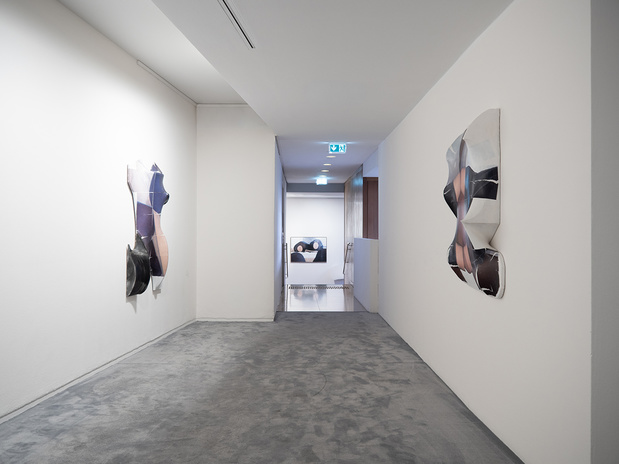
Perception itself is subtly reversed. The body and its organs become motifs. Artificial materials mimic the permeability of flesh, while manufactured objects begin to resemble living organisms. Iridescent door handles, for instance, appear like eggs on the verge of slipping from their supports, or ripe fruit suspended within an unpredictable process of evolution. Growth, outgrowth, decline and inward growth become entangled notions, mirroring a practice that continuously multiplies its own complexities rather than resolving them.
With extraordinary formal intelligence, Mo Rielly’s inventions integrate themselves into the architecture of everyday life. Fire alarms, surveillance cameras and other functional devices become part of a wider conversation, revealing themselves as pathological extensions of a social body in flux. Her works colonise the space even as they are colonised by it. Within them, other forces and other ideas seem to emerge, participating in a movement of thought that can be sensed but never fully deciphered.
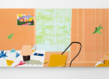
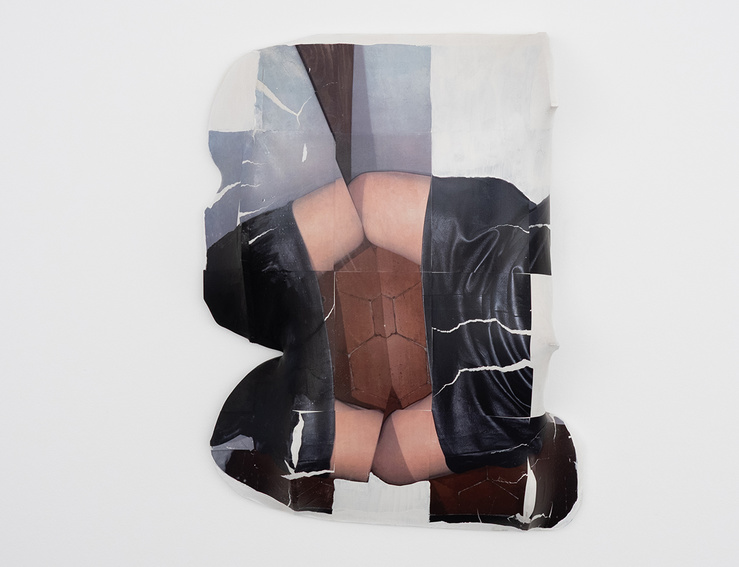
One such example is a convector casing: an anonymous metal enclosure split open, grafted with a new skin and topped with an image that returns us, as all of the artist’s works do, to an ongoing dialogue with form itself. Born in the studio, the form still carries traces of its making, retaining something of the warmth of its own elaboration while remaining fundamentally dependent on the material from which it arises.
Every tension, every line of flight and every symbolic element points back to a dynamic relationship between solid forms and expanding, elastic matter. Human thighs stretching a leather skirt become an emblem of this encounter. The exhibition’s visual language is highly seductive, deeply unsettling and formally compelling. Its power is amplified by the artist’s fluid use of multiple media. By bringing together materials as apparently opposed as wood and metal, Mo Rielly creates a dialogue that extends beyond questions of form to touch on a more universal imaginary, one that escapes the trap of dualism. Familiar domestic images, such as the persistent presence of a radiator inhabiting our most intimate spaces, are brought into contact with the limitless life of the imagination that gathers around them and unfolds into ever new possibilities.
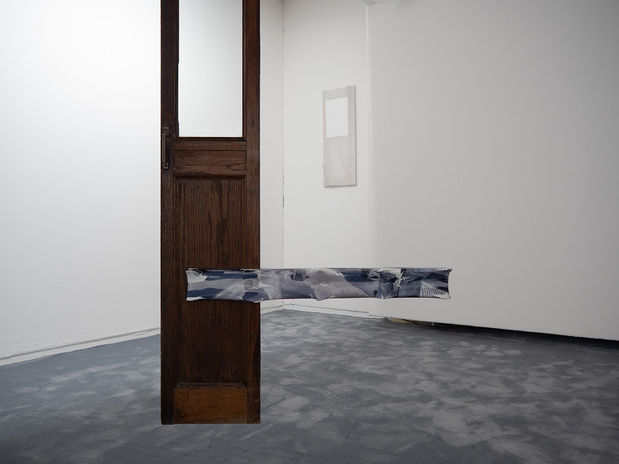
The exhibition is never really about warmth or coldness. Instead, the intensity of these works acts directly upon perception, unsettling expectations and blurring sensory boundaries in ways that bring us closer to ourselves and to the almost incantatory magic of simple contact with the world. What emerges is the vertigo of touch, endlessly renewed and capable of reshaping our relationship to reality.
In this sense, Mo Rielly’s work moves beyond any straightforward notion of care that the use of humble or found materials might suggest. It belongs instead to a genuinely restorative process, one in which the artist grants renewed vitality to every line, angle and fragment of a damaged object, enabling it to transcend its original condition. Through the repetition of an elemental gesture, she affirms the ordinary reality of our presence in the world and the sensory contact that continually returns us to it.
Winnie Mo Rielly, Infractuosité, on view from 10 June to 12 July 2026 at the European House of Photography, 5–7 Rue de Fourcy, Paris 4th arrondissement.