Claire Trotignon — La Maréchalerie de Versailles
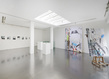
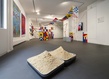
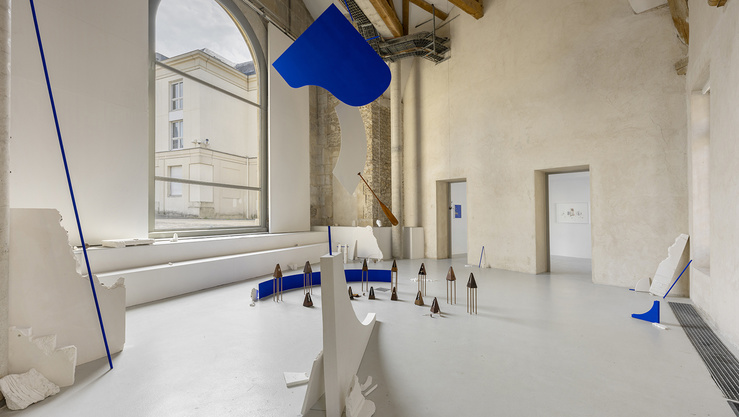
Claire Trotignon immerses us in the Maréchalerie of Versailles, at the heart of a delightful installation that translates into space the complexity and inventiveness of its solitary landscapes. There, time is frozen, like the silent metronomes that compose it, prisoners of a point of equilibrium that constantly threatens to collapse.
Everything in her work becomes a fragment of an infinite whole, whose uniqueness no longer constitutes an essence. Like that element of totality that, for those who pay attention, lies in every glance, every fragment of a vision bearing a virtual landscape, Claire Trotignon plays with this paradox of a minimalism that carries the greatest of riches, containing within it the potential of a world waiting to be unfolded. Drawing becomes the very substance of a space that it reorders, even redefines.
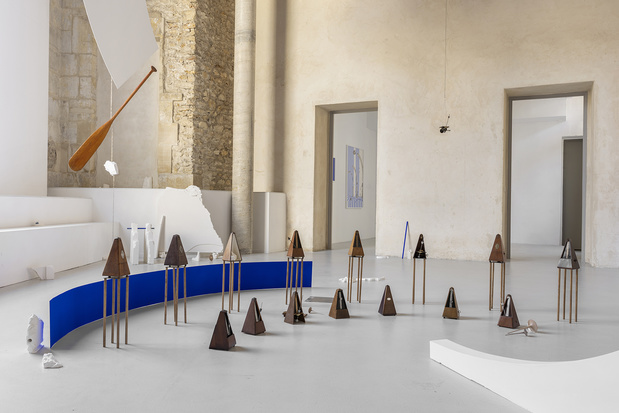
By anchoring her artistic reflection to the scientific and historical dimension of Christian Huygens, a leading figure in the thought and application of time measurement and a member of Louis XIV ’s Royal Academy of Sciences, the artist instills a paradoxically poetic dimension into her aesthetic invention. She establishes a dizzyingly coherent rationality at the heart of a network whose contrition is left to the visitor’s choice, inviting them to activate or deactivate these sentinels of existence. “Measurement,” in its full lexical scope, shines at the center of an installation that defies it. Time, architectural construction, and weighting harmonize in a pleasurable score where the succession of prepared elements, materials with contrasting characteristics, and singular motifs sets the rhythm, this time, of a silent flight.
In a mirrored fashion, his graphic works extend this great leap into a parallel horizon, nourishing the thread of an exhibition that hinges on the highly productive tension between the initial immobility of the installation and the frozen state of a collection of elements that the encounter with the viewer ineffably sets in motion. This movement is that of natural light received from the outside, and of its reflection and capture by subtly different materials. Each object, whether identifiable or fragmentary, becomes part of a dynamic whole, even as it appears to assert its tranquility, its ethereal fixity. Each one then carries a singular principle of movement, permanently altering our understanding of this concept, which becomes as plural as the sum of all possible displacements and pauses.
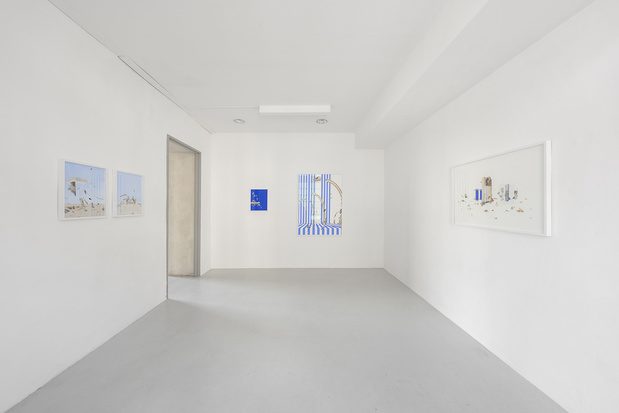
The artist thus reverses perspective (and expectations) in a work that celebrates horizontality, using radical verticality to convey the extent of its depth. Like so many fragments of a past that is far from over, multiple elements dot the space and enclose us, without imprisoning us, within a composition that transforms its voids and negatives into stages of a construction that we are invited to inhabit, through our dreams as well as our bodies.