Claire Tabouret — Le Grand Palais
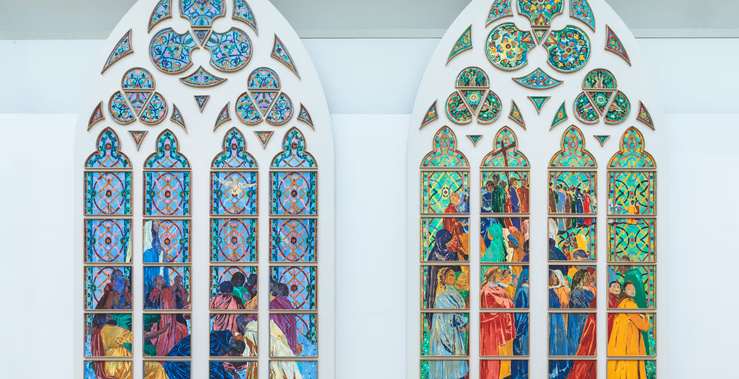
The exhibition Claire Tabouret, D’un seul souffle, presented at the Grand Palais from December 10 to March 15, 2026, offers a low angle view into the artist’s project for the recreation of part of the stained glass windows of the church of Notre Dame de Paris. Faced with the demands of such a commission, what remains of the strength of an artist who has always been defined by boldness and by the ability to embrace powerful themes while reinventing her gaze?
The restraint and the almost programmatic absence of risk taking in these paintings, like their subjects, is surprising. In this sequence, invention seems muzzled. The work, steeped in a mystical imagery that repeats itself without surprise, appears to have flattened the legends preceding this formalization of a feast by the Church, yet numerous and which could have infused and derailed this fantasized imagery of the universalism of an institution that continues every day to betray it. It is easy to imagine that the political scope of the project and the grip of authorities claiming the role of critics have curbed any genuinely artistic ambition. It remains nonetheless heartbreaking to observe this impact when it strikes an artist of Claire Tabouret’s stature, capable of such profound invention and self questioning in her usual work.
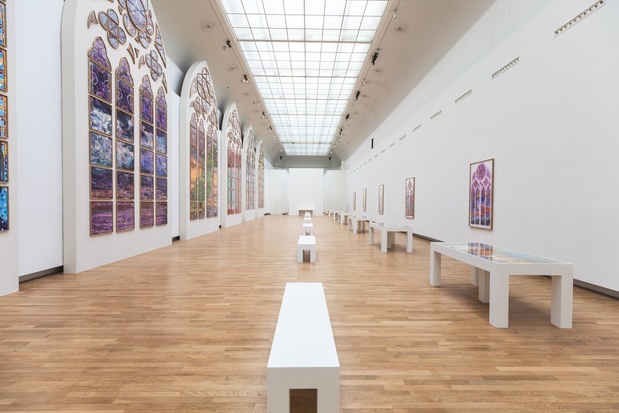
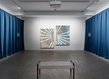
As for the exhibition’s scenography, it once again borders on disrespect within the space of the Grand Palais, which is clearly far from ready for its reopening, now a year ago. A soulless and idea less succession of compositions throws the work to the public like fodder, gathered on one side of the space with the bleak regularity of a Sunday morning mass. Given the stakes and the curiosity of an audience determined to question the choice of the artist, this block like presentation, devoid of any reflective and problematized accompaniment, is sorely lacking in ambition.
Taking Pentecost as its theme, Claire Tabouret chooses harmony as the guiding thread for a variation on unity in diversity. Composed of six bays each dedicated to a figure sanctified by the Church, the ensemble alternates subjects such as communion scenes, mass processions and natural landscapes, each time responding to a quotation. Echoing this founding episode, she indeed seeks to convey the outward reach of Pentecost, this mythological discovery through the senses of the divine nature descended once more among humankind.
One perceives, in the suspension of gazes and in the almost total erasure of bodily singularity, a form of magnetism issuing from off screen space, from the divine. It is certainly in this withdrawal of the human, in this ethereal destruction of individual singularity, that the artist most effectively responds to the Catholic interpretation of the episode, reducing the individual to a mere servant, the first conveyor of the spectacle of his finitude. And as the bearer of an original fault that allows the institution to erect itself as the mouthpiece of a morality defining the norms of its body, the inequality according to it of its genders, and the very humanity of its sexuality.
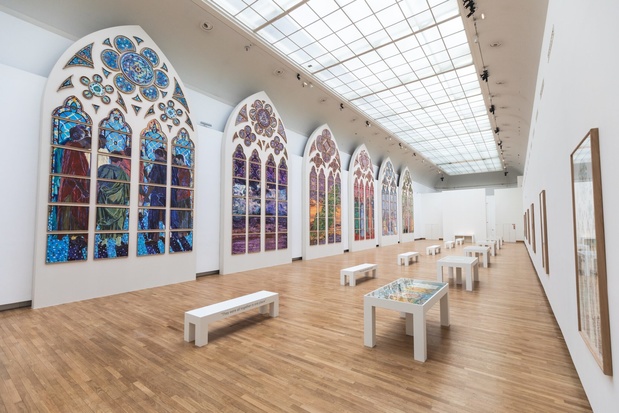
A corset that everyone is free to appreciate but from which the artist’s work only slightly deviates. While the whole maintains chromatic and formal coherence, certain singularities emerge: a more insistent gaze, a detail that adjusts the focal length and allows an strangeness to protrude, breaking the unity. Like that female face that bursts forth with an internal imbalance without fully convincing. Points of interest, then, but far from numerous enough, and themselves tipping into the pathos of their context. One may especially regret that the study facing the bays, which fully embraces this dissolution of identity to the point of disintegration, did not find a more organic place within the ensemble itself, amplifying the argument through a strong gesture.
Despite the palpable constraints, certain traits remind us what a great painter Claire Tabouret is, capable, through a subtle difference in the treatment of neighboring contrasts, as in the case of two female faces in particular, of producing a visual hiatus that floods the surrounding space with an impossible light and grants her gazes the vertigo of infinite depth. The sacrifice to institutional demands, if it curbed boldness, may not have been in vain if it allows us to uncover these flashes that prove that art, even when subjected, retains its rights.
As a mediator of an institutional constraint that exceeds our present moment, the painter thus manages, even with difficulty, to make the murmurs of her singularity rustle. In doing so, she constructs a work which, by avoiding frontal confrontation, both in gaze and in subject matter, articulates and materializes itself with the transparency promised by its support.