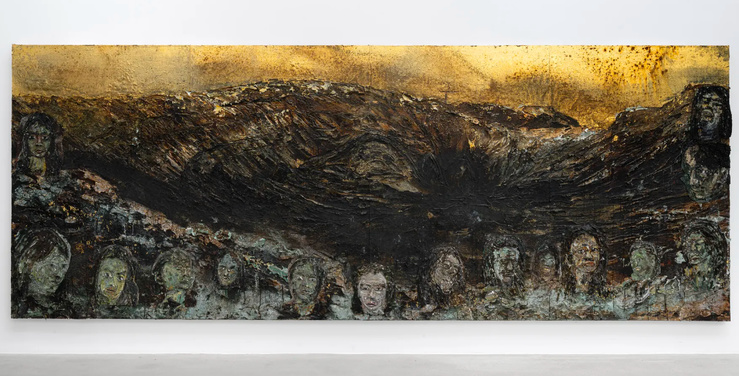
Anselm Kiefer — Galerie Thaddaeus Ropac, Pantin
Presented at the Thaddaeus Ropac gallery in Pantin, Nymphäum by Anselm Kiefer feels like a turning point, even within a body of work that has always thrived on scale, density and ambition.
Anselm Kiefer — Nymphäum @ Thaddaeus Ropac Paris Pantin Gallery from April 25 to October 25. Learn more Kiefer has never been an artist of restraint. Here too, he pushes things to the edge, but without tipping into excess for its own sake. Instead, something more unexpected takes shape. The vastness of the space meets a quieter, inward pull, as if the work were testing how far it can move from monumentality toward something more intimate, more uncertain. The tone is less declarative than it might once have been, more open, even vulnerable.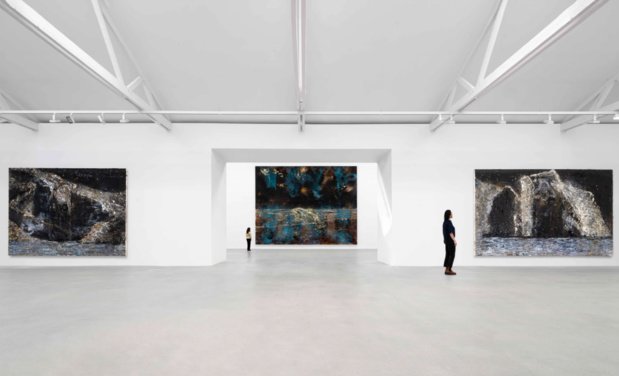
Mythology runs through the exhibition, though not in any fixed or illustrative way. Nymphs appear and dissolve, often indistinguishable from the landscapes around them. Bodies merge with trees, with ground, with air. At times, a face looks out with striking clarity; elsewhere, forms seem to flicker and slip away. What emerges is not so much a cast of figures as a shifting field of presences. Occasionally, something steadier asserts itself, an animal form, a vegetal mass, carrying a kind of grounded force that quietly reshapes the surrounding space.
The exhibition unfolds with a strong sense of rhythm. Moving through it, you become aware of how scale and pacing guide your attention. Some works open out, almost architectural in their clarity. Others draw you in, dense and difficult, resisting easy reading. The effect is physical as much as visual, a constant adjustment between distance and proximity, between looking and searching.
Many of Kiefer’s familiar motifs are here, trees, paths, fragments of built structures. Yet they feel less like symbols than like traces, elements of a world that is both imagined and deeply felt. Words seem to recede in the face of this material intensity. What takes over instead is something more elemental, roots, textures, accumulations that suggest a nature we are part of but cannot fully comprehend, even when we attempt to shape it.
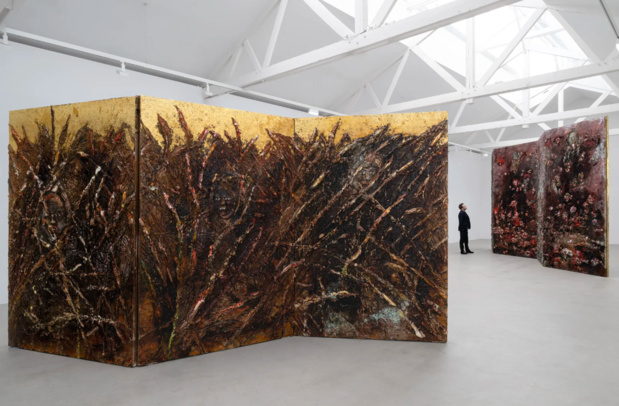
There is also a subtle shift in mood. Where Kiefer’s work has often confronted history, here there is more space for drift, for ambiguity, even for a certain lightness of touch. The surfaces themselves seem to open, as though punctured from within, allowing glimpses of other possible horizons.
The figures drawn from myth no longer feel quoted or imposed. They appear to surface from the material itself, as if they had always been there, waiting. Painting becomes less an act of construction than of uncovering.
By the end, figuration loosens its grip. What remains is a more fluid, less defined space where memory, matter and imagination intermingle. Kiefer is no longer simply telling stories. He is circling something harder to name, a sense of time that stretches beyond narrative, and a future that remains unresolved, but faintly, persistently present.