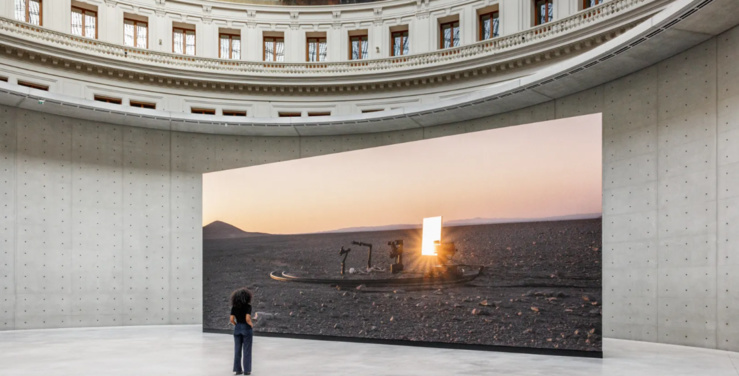
Clair-obscur, Bourse de Commerce, Paris
While the Bourse de Commerce, with Clair-obscur, offers a journey of deliciously philosophical, profound, and deeply engaged ambitions centered on the question of the gaze, it stumbles upon a haphazard construction, multiplying the spotlight on artists without fully committing to a monographic approach, nor truly living up to its promise.
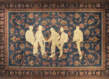
Clair-obscur @ Bourse de Commerce from March 4 to August 16. Learn more First and foremost, Victor Man’s paintings (undeniably skilled and certainly profound in their counter-temporal progression) are here pushed into their most dismally decorative dimension, mired in an obscurity bordering on kitsch, as if their secrets required the decor of a cabinet of curiosities to justify them. This abrupt emphasis, while not exactly undermining the baroque vanity of James Lee Byars, honored on the ground floor, fails to harness the stark spectacle of death for its own narrative.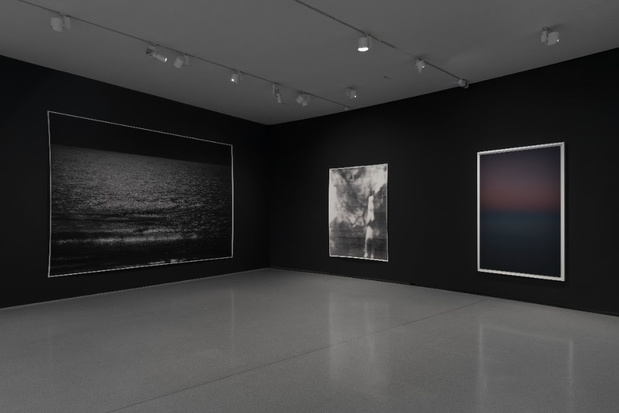
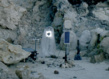
The result is beautiful promises but a clear taste of the unfinished, as even the large-scale works struggle to fully convince on their own merits. One remains largely skeptical of Pierre Huyghe’s video, which, beyond the beauty of its imagery and the fruitful confrontation it seeks between dead organic matter and moving technology, shaking as if driven by a symbolic mission in the face of an absurd sacrifice that brings us back to our condition, stretches into the weightlessness of a meaning that plunges us even deeper into its stigma. Claiming to outwit time (200 hours constantly rearranged), the video evades all commitment, all substance, arguing only its protocol. Behind the visual effectiveness of its device, it defends nothing but the mere advertising value of the moving image, reduced to its plastic countdown function, merely passing time for others.
The overall reflection of the exhibition, while articulating contrasts and references to the chiaroscuro of an art history here replayed with and adapted to contemporary anxiety, still lacks cohesion in its argument and breadth in its selection to successfully invent a new narrative. Impervious to a philosophy of becoming that has rethought the very relationship to disappearance and its specters, the deployed thought drifts aimlessly, hoping that sheer accumulation will somehow coalesce into a coherent problematization. Thus the sections follow one another, playing on keywords in a score that could be stretched to infinity, condemning, by the little regard it shows, certain works to the status of accessories. Bruce Nauman’s striking fountain fades behind the transparencies it plays with, slipping unnoticed between a fire extinguisher and a window that blur its very clarity. Wolfgang Tillmans and Trisha Donnelly enter, almost by force, into a dialogue of the deaf where chromatic codes, too similar, verge on forced rhyme. And one bends under the paroxysmal lessons of an Yves Tanguy multiplied here to the point of nausea, under the proliferation of a Louis Soutter parodying a totemized parietal art, and under the symbolic weight of a Bill Viola toying with the elements for his own greatest pleasure. Ours is to be found elsewhere.
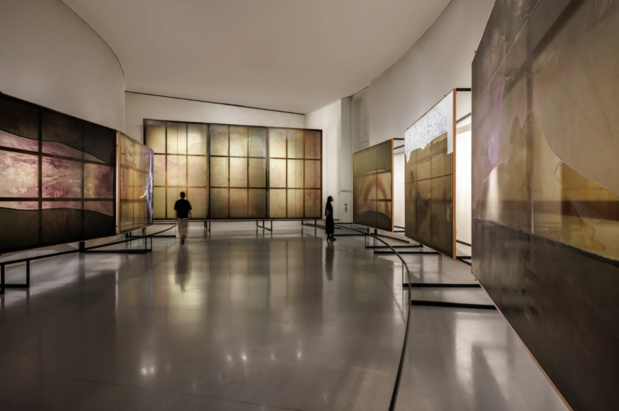
On the contrary, once freed from any desire to make an exhibition, from any pretense of coherence, one leaves happier to have rediscovered (or discovered) the powerful highlights of Sigmar Polke’s Axial Age installation, this time left in the pure sobriety it demands and rich with a wild imbalance perhaps best suited to the interplay of philosophy and history; the ever-stunning video Crossroads by Bruce Conner; the fascinating video by Hanka Wlodarczyk, in which the sculptures of Alina Szapocznikow haunt an abandoned city, repainted in the « glass red » of the artist’s fragile lips.
And even the stark aridity of a Robert Gober appearing at the end of the journey with a boldness that might well be a tribute to this unbridled invention, pushing art toward its brightest creation: leaving the spectacle behind the darkness of a door that can never be opened. And making it, in turn, the pinnacle of the representation. Now that’s clear.