Miriam Cahn — Galerie Jocelyn Wolff, Paris
Miriam Cahn presents Still Leben at Galerie Jocelyn Wolff, an exhibition of striking beauty. Its emotional impact is all the more intense as it relies on a frontal and pared-down approach, capable of stunning the viewer and lingering in the memory of anyone who encounters it.
Miriam Cahn — STILL LEBEN @ Jocelyn Wolff Gallery from March 14 to April 25. Learn more The exhibition opens with a sense of shock. For the occasion, she entirely abandons the human figure and its body whose tensions she has tirelessly explored, whose distortions she has rendered as so many pieces of evidence in the trial she conducts against the world. The works in this exhibition assert themselves in their raw necessity, in the frontal evidence of an art that speaks, screams, and groans at close range. An art that aligns itself with the codes of the diary ; a domestic life that is no less life for being so. No longer a dreamed (or nightmarish) life, but a life as it is. A decisive and “material” shift for an artist who once showed the reverse of bodies and the obverse of their destructive drives. She now follows, in negative, their overflow; the objects presented here are destined to encounter it, in the banality of their everyday existence, with no other claim than that of existing.In the early 1980s, when she painted houses, they seemed to expel their own inner shadows; the few other objects (a computer, for example, already appearing as early as 19821, and present here as well) participated in a projection of the interior, as if it were spilling its guts into the face of the world. A dynamic that offers a key to reading a body of work which, by confronting us with the litany of its possible self-destructions, has never ceased to capture what, “despite everything,” continues to work in favor of life.
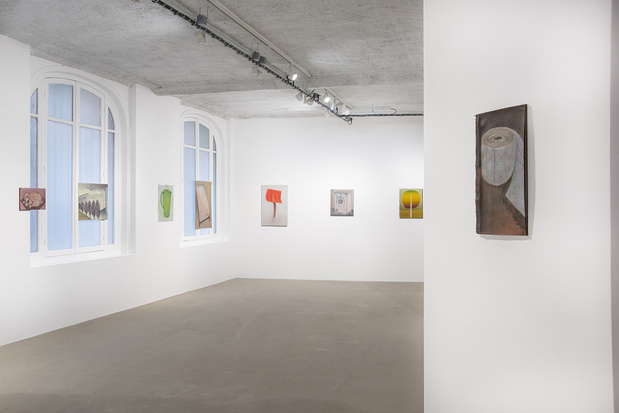
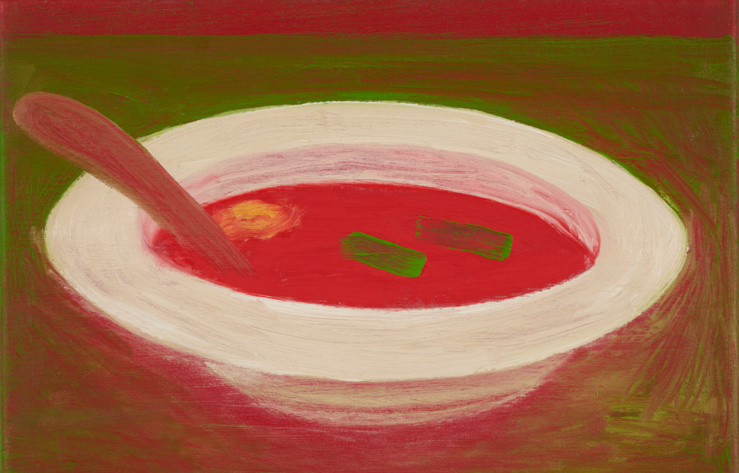
With acanvases of varying sizes, each depicting a portrait of an object, the unfolding of these domestic figures forms a continuous melody, less an inventory than an attempt at exorcism: a way of shedding these memory-objects that inhabit the intimate sphere. The object, in its very normality, becomes a phenomenon here — a witness to a temporality that flows without ever dissolving on its own. As an affected double, material life continues its cycle alongside us.
To paint what surrounds us, rather than the bodies of others, remains a way of speaking about oneself. But is it therefore a form of withdrawal? The works deploy a singular touch, capable of maintaining blur while at the same time making the organic materiality of forms erupt. The image oscillates between approximation and abrupt capture, as close as possible to an almost physical sensation. In this in-between space, where truth and memory, reality and approximation, image and reconstruction intertwine, a fortress of strange beauty takes shape, all the more solid as its ramparts remain shifting. Something, here, is released. Through drawing, objects detach themselves from the strange indeterminacy that binds them to our bodies. Daily extensions of it, inscribed in memory yet never truly fixed, they hover between two states whenever they must be brought forth ex nihilo. The analogy with the bodies of others, the flesh of those close to us for example, which we never truly possess, and even less so in memory, proves more tenuous than one might expect.
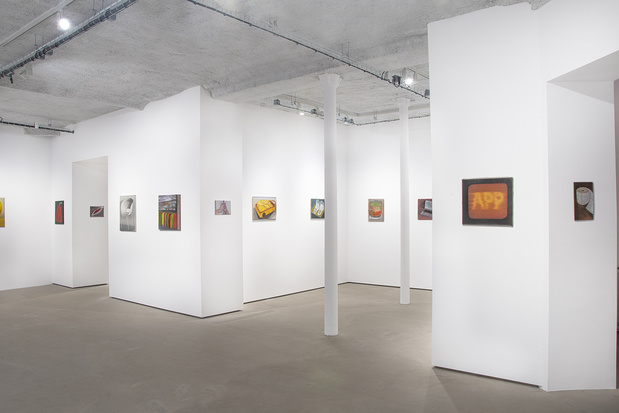
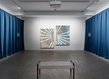
The gaze is then caught in an infinite melody. The artist captures the salient points of her immediate environment and integrates them into the alphabet of her images. Details blur, materials overlap, aberrations proliferate until they disturb our own perception. The banal, though confined within the frame, resists. A drip, a crackle of color is enough to tip the image: the present becomes an offering to time, and the trace, an event. The scenography extends this gesture. It occupies the space with an almost obstinate regularity, without breaking its rhythm, even inscribing itself onto the windowpane. A feat that restores a fully embodied insistence to this project, one that in no way separates creation and thought from life. What hierarchy remains when thinking the violence of the world and the future of our humanity coexists with cooking a chicken or the need, once again, to possess toilet paper?
Perhaps we can then unfold the polyphony of the exhibition’s title, Still Leben, “still life” in German, which also suggests that which continues to live in silence. One might hear in it an affirmation: we are still alive. The memento mori of vanitas (“remember that you will die”) transforms into a more urgent injunction: remember that you are alive. Every battle begins here.
1 Das Klassische Lieben, 1982, explore here