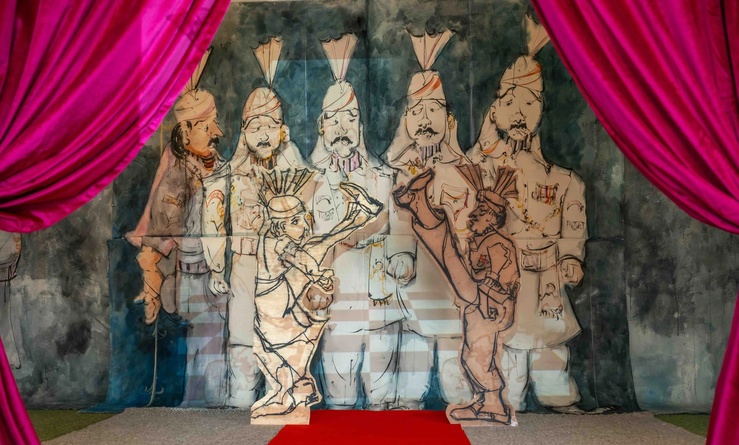
Aiza Ahmed — Prix Artsy Vanguard 2027
Winner of the first Artsy Vanguard Acquisition Prize, awarded by Artsy in partnership with the Brooklyn Museum, Pakistani artist Aiza Ahmed, living in New York, invents, at the crossroads of her personal history and collective memory, a joyful universe teeming with stories blending traditions of the Indian subcontinent, questions of identity, borders and masculine figures of authority.
Born in Lahore in 1997, trained at Cornell University and holding an MFA in painting from the Rhode Island School of Design, the artist uses a multitude of media, including painting, drawing, sculpture, video, and installation, to stage the effects of these representations, sometimes grotesque, sometimes frightening, but always playing on the mediation of the gaze. The rough draft and the approximation, as well as the delightfully old-fashioned quality of pen-and-ink illustrations reminiscent of 19th-century sketches and a dry wit, thus constitute an essential vector in her way of distancing herself from the very real problems that constrain people and bodies, freezing the postures of both victims and perpetrators, members of communities and those excluded from them.
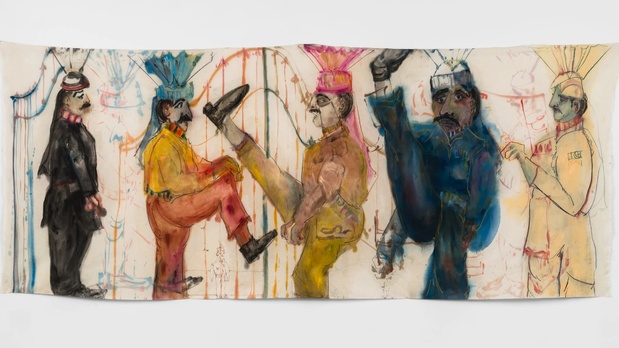
Migration and belonging to a land, crucial issues in his observation of the world, then impart a permanent movement to devices (and bodies) frozen in an imbalance whose humor, theatricality, references to traditions as well as to cinematic culture intertwine feelings with a thrilling energy.
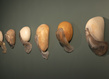
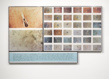
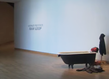
Emblematic of his open-minded approach to creation, his first solo exhibition at the Sargent’s Daughters gallery in New York draws inspiration from Satyajit Ray’s Music Room (1958) to create a narrative installation that reenacts the twilight of imperial splendor, which the movements of history will bring down (sometimes only to better transfer its pleasure). Paintings, sculptures, and a sound installation explore this everyday life lived in reverse of the surrounding dynamics, where beings, however similar they may be, evolve in almost separate worlds.
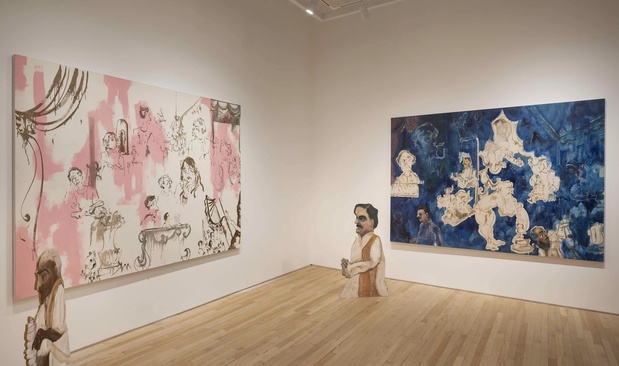
Through the speed of her gesture, the accuracy of her observations and the audacity of her spatial arrangement, Aiza Ahmed then created a total proposition whose freedom and inspiration resonate insistently in the ear of a contemporary world whose problems, although ordered differently, refer to the same feeling of disconnection, fascination and gap between consciousnesses.
Above all, it establishes a link that lends complexity to a work that manages to confront nostalgia, spectacle, and political stance in the face of powers based on their representative and performative dimension. Authority, like the masculine figure, draped in its finery and undermined by its aesthetic imbalance, is transformed into a cheap, stupefying stupefaction that emphatically loses itself in its own rules.