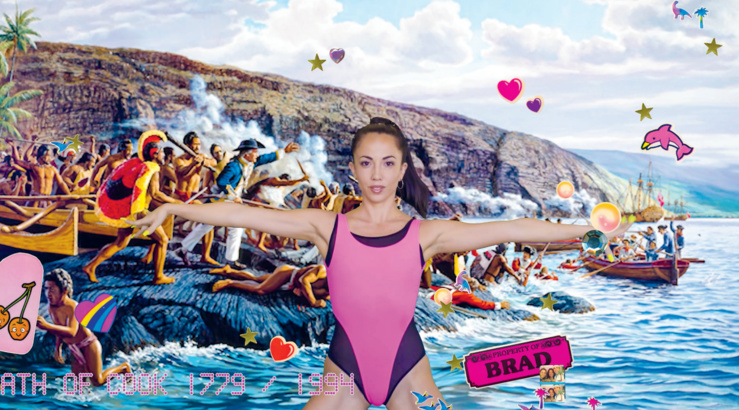
Biennale du Whitney 2026, Whitney Museum of American Art, New York
Relying on a stimulating reflection on the generative power of art and its capacity to create elements of a new order, the Whitney Biennial 2026 presents an edition that enacts the de-hierarchization of a value system whose contemporary history exposes its undeniable fragility every day. We offer a focus on major figures of this exhibition, which promises to be essential.
The selection, which seemed rather eclectic on paper, is no less so in images, but bringing it together makes the evidence clear; these choices are the right ones, and the installation is likely to be sumptuous, confronting generations (from the eldest living artist, Carmen de Monteflores, born in 1933, to Taina H. Cruz, born in 1998) as well as geographical origins. The works engage all the senses, generations collide with concerns and aesthetic statements that seem to have digested seventy years of invention to forge, each in their own way, an unprecedented and immediately readable grammar. We present a selection of some of the most remarkable and anticipated artists of this new edition.
Basel Abbas and Ruanne Abou-Rahme
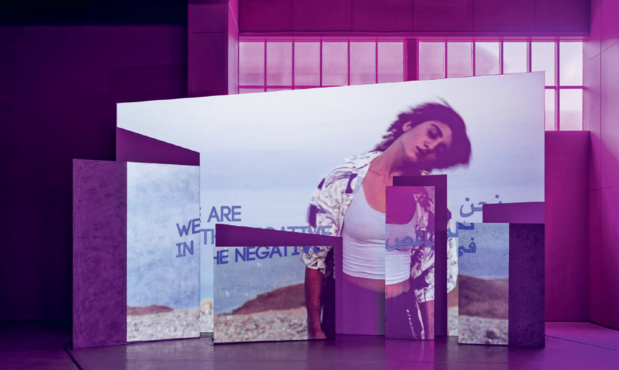
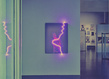
Palestinian artists (both born in 1983) working between New York and Palestine, Basel Abbas and Ruanne Abou-Rahme develop a practice combining video, text, sound, and performance to examine colonial erasure, exile, and resistance. Their work explores what they call “becoming the negative,” that is, transforming a condition of invisibilization into a space of critical power. “We are the negative unbound,” they assert, claiming an art that refuses capture and imposed frameworks. Through immersive installations where the image fragments, violet inverts perception, and sound symbolically passes through walls, they shift the notion of testimony toward active engagement. Their work responds to a “call” from their community, amplifying voices threatened with erasure. Between memory of prisoners, songs, writings, and sensitive relations to Palestinian land, they conceive each project as a collective act, a poetic and political gesture embedded in a global struggle against systems of oppression.
Kelly Akashi
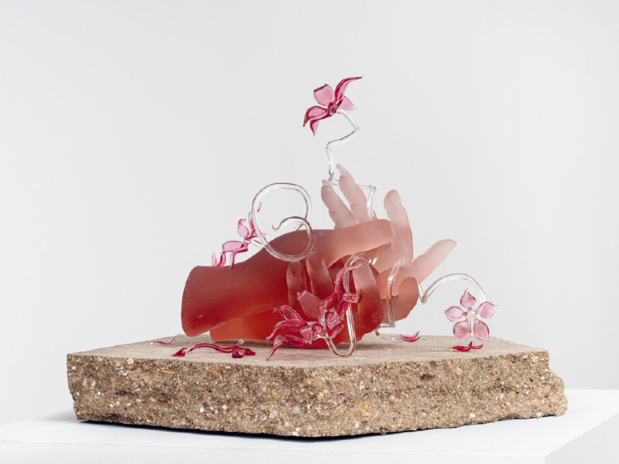
Born in 1983 in Los Angeles, where she lives and works, Kelly Akashi develops a sculptural practice that interrogates time, memory, and mortality through materials charged with symbolism such as glass, bronze, stone, or wax. Trained in photography before turning to three-dimensional work, she seeks to inscribe the image in lived space and duration. The spiral, appearing very early in her work, has become a central conceptual model: “The spiral as a model has helped me materialize abstract concepts like time,” she states. This form allows her to conceive of non-linear time, composed of returns, transformations, and interlacings. Akashi engages in a careful dialogue with material, accepting loss of control to allow the unforeseen. Her repeated castings of her hands (in wax, bronze, or glass) constitute a sensitive index of changes in her body, an intimate archive confronted with the erosion of time. By extending her reflection to geological time, stones, and trees bearing witness to history, she links personal experience to broader temporalities. Her works, often described as “intimate monuments,” articulate fragility and resilience, presence and disappearance, in a profound meditation on what endures.
Kamrooz Aram
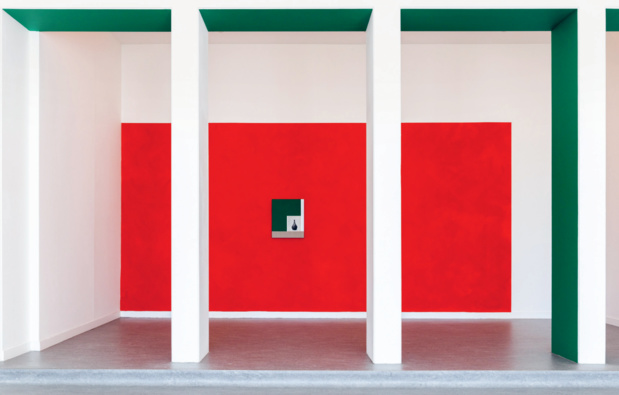
The practice of Kamrooz Aram (Iran, 1978) questions the boundaries between ornament, decoration, and content. He rehabilitates ornament, often devalued by the history of Western art, turning it into a formal and political language. His paintings, constructed through layering, erasure, and reconstruction, reveal the memory of gestures and times, transforming each canvas into a living palimpsest. The grid, which he considers the root of ornament, structures his compositions but dissolves into arabesques and curves, challenging modernist rigidity. His collages and installations, inspired by architecture and museums, question the neutrality of exhibition spaces and the hierarchy between art and craft. While Kamrooz Aram claims an abstraction rooted in history, culture, and emotion, rejecting the idea of apolitical art, his work—between painting, sculpture, and exhibition design—celebrates the trace of others, hybridity, and the resilience of creation in the face of oblivion.
Ash Arder
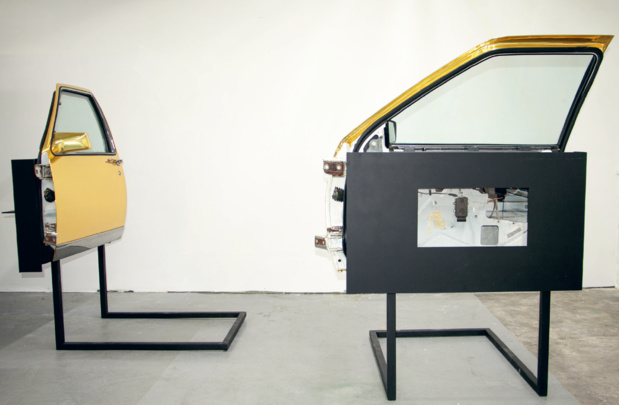
Born in 1988 in Muscatawing (Flint, Michigan), Ash Arder lives and works in Waawiyatanong (Detroit). Their practice crosses sculpture, installation, sound, and solar systems to explore connections between energy, family memory, and industrial heritage. From a family marked by the Great Migration and work in the automotive industry, Arder investigates tensions between Black middle-class comfort, labor history, and racial and environmental violence. Solar energy, central to their practice for a decade, becomes both a technical tool and a symbolic gesture: a way to honor finite resources and bring together human and non-human communities. Works such as Consumables or Broadcast link agriculture, Black American music, and DIY technologies, making sound, seeds, or solar refrigerators into political microcosms. Between garden, archive, and dance floor, Arder conceives art as a space of collective activation, where the object becomes a catalyst for memory, care, and transformation.
Teresa Baker
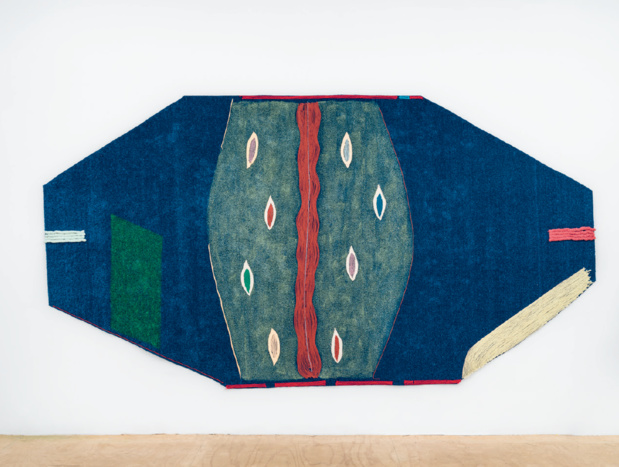
Of Mandan and Hidatsa descent, Teresa Baker, born in 1985, grew up across North Dakota, Montana, Nebraska, and Oklahoma before settling in Los Angeles. Her work explores the links between contemporary abstraction and the memory of the Great Plains landscape. After a decade of experimentation, she adopted AstroTurf as her primary medium: an industrial, non-precious material that allows her to “draw” directly into the matter by cutting, adding wool, leather, or bark. Her works, on the border of painting and sculpture, compress three-dimensional space into the plane. Using a material considered ordinary affirms formal freedom and assumed physicality. Without resorting to explicit symbolism, Baker dialogues her Indigenous heritage which is visible in certain geometries and attention to negative space with the history of Western abstraction. Her work thus opens a space where identity, territory, and formal language coexist without reducing one to the other.
Sula Bermudez-Silverman
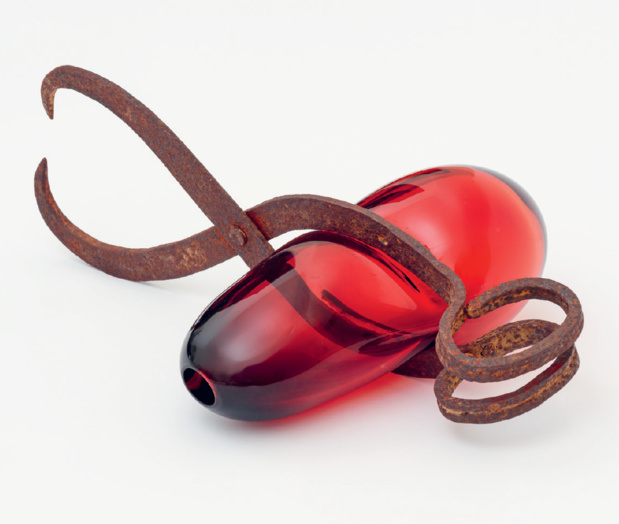
Born in 1990 in Los Angeles, where she lives and works, Sula Bermudez-Silverman develops a sculptural practice that explores the buried memories of objects and the invisible circulations of history. Through blown glass, sugar, salt, or metal, she creates tension between formal beauty and symbolic charge, revealing the political and affective layers contained in everyday artifacts. Her works juxtapose fragile materials and industrial devices (traps, shears, molds, domestic architectures) to examine mechanisms of power, defense, and camouflage. The house, a recurring motif, becomes a condensation space between intimate memory and collective catastrophe, notably after the Altadena fire that marked her family history. By exposing production processes and material genealogies, Bermudez-Silverman evokes a personal and geopolitical unconscious. Her work, both alluring and unsettling, acts as a revealer: it transforms the object into a shifting symbol capable of linking extraction, consumption, and desire within a single critical constellation.
Zach Blas
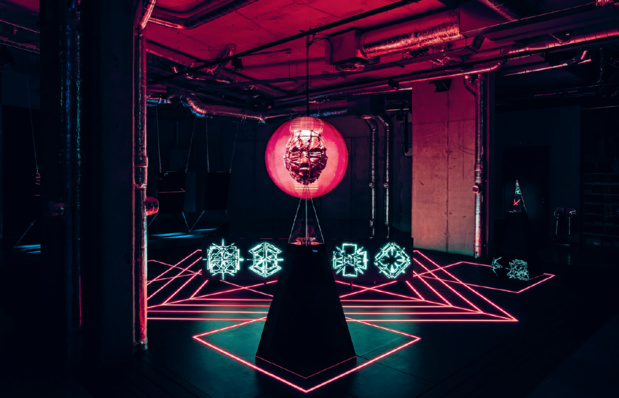
Zach Blas (1981, United States) is an artist and media theorist. He lives and works between London and the United States. Trained in visual arts and digital culture, he is also a professor, having taught at the University of California, San Diego, and the Royal College of Art in London. His practice sits at the intersection of contemporary art, philosophy, and technology. Blas focuses on surveillance systems, artificial intelligence, and facial recognition regimes, analyzing them through the lenses of queer theory and critical race studies. His emblematic project Facial Weaponization Suite (2011–14) proposed collective masks with abstract forms designed to evade biometric algorithms, transforming technological disobedience into a sculptural and performative gesture. His video installations and immersive environments often draw on science fiction, mythology, and political speculation to imagine alternative futures. Rather than criticizing technology from the outside, Blas infiltrates its logics to reveal ideological biases. His work thus asserts a critical stance toward technological solutionism, proposing forms of opacity, solidarity, and collective resistance in the algorithmic age.
Leo Castañeda
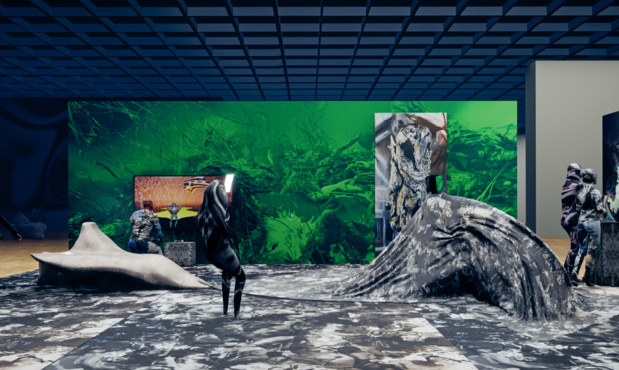
Positioned at the intersection of surrealism, gaming, and installation art, Leo Castañeda creates hybrid worlds where painting, technology, and storytelling converge. Influenced by his grandmother, painter Maria Thereza Negreiros, and by Roberto Matta’s weightless imagery, he constructs immersive environments in which gravity and matter become fluid illusions. His ongoing project Camoflux: Levels and Bosses transforms paintings and drawings into explorable digital landscapes, inviting players to navigate evolving ecosystems. Through his concept of “exponential reciprocity,” Castañeda proposes a feedback-driven ethics of interaction: “So if you’re kind to the landscape and calmly address its needs, then the boss cares for you and lets you pass through. But if you’re destructive… the boss throws the entire landscape towards you.” Bridging museums and gaming conferences, his work positions video games as a critical medium for reimagining our relationship to environment, AI, and collective futures.
Taina H. Cruz
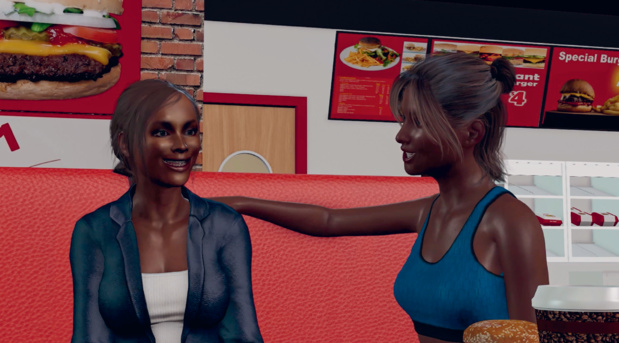
A true product of New York’s cultural ferment, Taina H. Cruz (1998, Puerto Rico) plays with scale to invent life-sized theaters where all five senses are constantly engaged. Steeped in popular culture, exchange, and the immediacy of artistic expression within public spaces, she multiplies plastic experiences, making play the driving force of an explosive, curious, and attentive creative practice. Image and communication slide through her works from seduction to excess, distorting reality toward its most grotesque aspects. In her pieces—direct and joyfully monumental—her Afro-Caribbean cultural heritage, her taste for technology, and her desire to bring to life stories as intense as those that mark childhood games all collide
Maia Chao
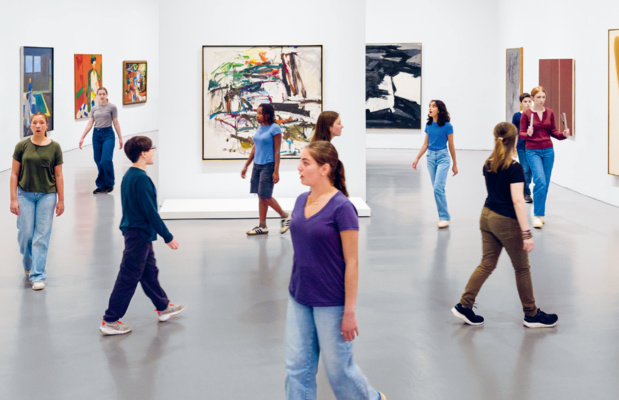
Maia Chao is a Philadelphia-based artist whose performances, videos, and collaborative projects examine the moral contradictions embedded in contemporary institutions. Born in 1991 in Providence, Rhode Island, she reflects on what she calls a state of “moral injury,” the psychic toll of participating in systems that conflict with one’s values. Her works often stage absurd or suspended situations—waiting rooms, landfills, bureaucratic rituals—where meaning falters and repetition unsettles fixed narratives. Moving between intervention and affect, Chao increasingly embraces art as a speculative rehearsal rather than a solution. As she explains, “I like the idea of an artwork as a space to rehearse different ways of being.” Through choral performance, looping gestures, and collective processes, she creates spaces that resist closure and “hold open the future without delivering it.”
Carmen de Monteflores
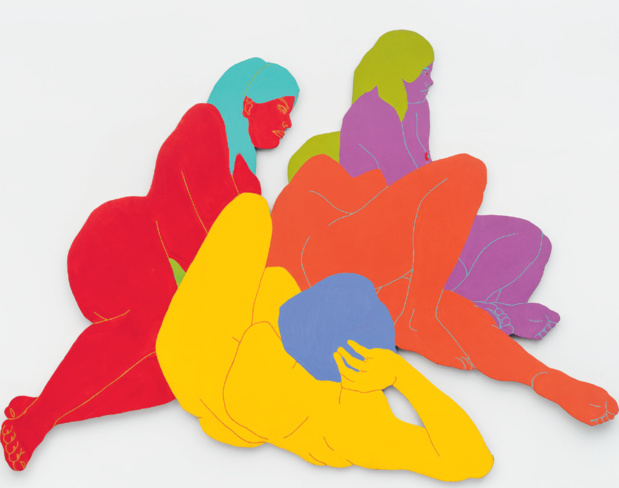
Carmen de Monteflores, born in 1933 in San Juan and based in Berkeley, emerged in the 1960s with bold shaped canvases that bridged Pop Art, Color Field painting, and early feminist expression. Educated in Puerto Rico, Paris, and New York, she developed a visual language grounded in contour and saturated color. Reflecting on her early work, she wrote, “I have a natural inclination toward clear shapes and unmixed colors,” a statement that captures her commitment to direct form and luminous palettes. Her large-scale cutout paintings of heads and intertwined figures explore sexuality, identity, and liberation, shaped by the countercultural energy of late-1960s Berkeley. Despite producing more than twenty-five monumental works in just a few years, institutional rejection and limited support for women artists led her to stop painting in 1969, leaving behind a striking and rediscovered body of work.
Ali Eyal
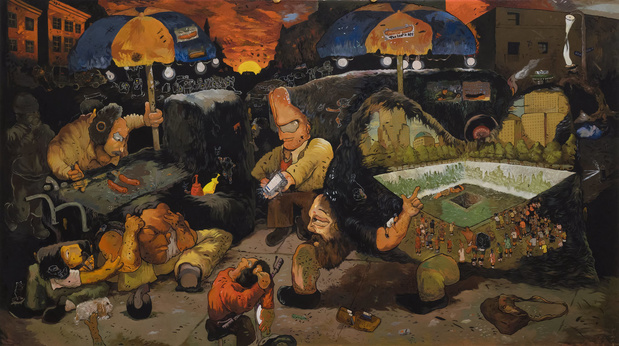
Ali Eyal, born in Baghdad and now living in Los Angeles, describes himself first and foremost as a storyteller: “I’m a storyteller. I feel like I have a book with me, an open book…” His multidisciplinary practice (including spanning painting, drawing, text, and installation) emerges from lived experiences of war, displacement, and survival. As a child, he drew under the shadow of propaganda; later, painting quite literally protected him at military checkpoints in Baghdad. His large-scale canvases conjure floating heads, haunted domestic scenes, and mythic landscapes where memory and fiction intertwine. Since moving to LA, his work has expanded in scale and chromatic intensity, retaining traces of Disney-like color filtered through dusk and loss. “Every head is like a universe of its own,” he says : each face opening onto unseen worlds shaped by grief, exile, and imagination.
Emilie Louise Gossiaux
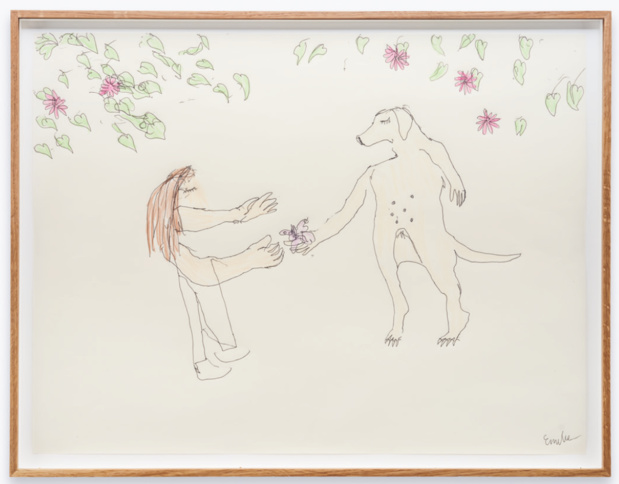
Born in New Orleans and based in New York, Emilie Louise Gossiaux creates sculptures and drawings that reimagine the relationship between humans and animals as one of shared agency and intimacy. Central to her practice is her dog London, who appears not simply as a guide but as a shifting relational figure (daughter, spouse, mother, partner). By destabilizing hierarchies and reversing symbols of control, Gossiaux transforms the leash and the white cane into poetic, ritual forms. “It’s really about asking viewers to recognize that there’s something powerful in an animal’s agency,” she explains. Working through touch, memory, and a vivid inner vision, she constructs a “third space” where blindness and visuality coexist, and where love becomes a radical force capable of reshaping power, embodiment, and kinship.
Raven Halfmoon
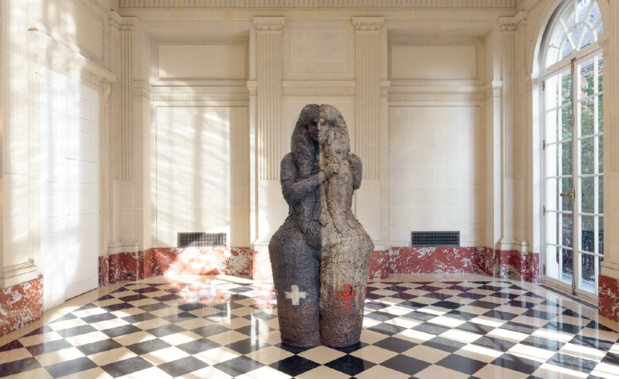
Born in 1991 in Oklahoma City and a citizen of the Caddo Nation, Raven Halfmoon creates monumental ceramic sculptures rooted in the ancient clay traditions of her people. Trained in anthropology and art, she hand-builds powerful female figures whose surfaces retain visible fingerprints and raw textures, conveying urgency and embodied presence. “I think of my sculptures as my family, my statements,” she explains. Her towering works—often depicting women with multiple faces—carry generational memory, resilience, and healing. With sculptures such as Flagbearer, nearly fourteen feet tall, Halfmoon reimagines the monument, centering Indigenous women within spaces that have long excluded them. Her striking palette of deep black, vivid red, and stark white reflects both Caddo pottery heritage and her contemporary life in Oklahoma.
Akira Ikezoe
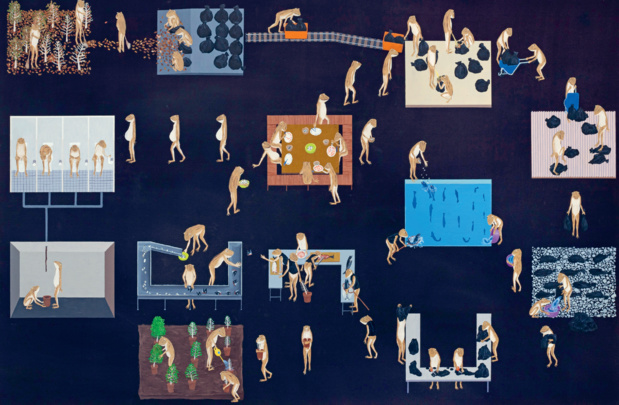
Akira Ikezoe creates intricately layered paintings that merge natural cycles with visual systems of association. Born in Kochi and trained in printmaking at Tama Art University, he adapted the discipline of print to oil painting, building images through successive thin layers that he partially removes to reveal forms beneath. Since moving to New York in 2010, his work has reflected on Fukushima and on the fragile boundaries between nature and culture. “When I find that the starting point and ending point meet, I feel—wow!” he explains, describing his fascination with circular systems. Drawing on diagrams of nuclear plants, financial charts, or weather systems, Ikezoe flattens time and hierarchy, making humans mere components within larger mechanisms. In his imagined worlds, seeds become windmills and suns sit outside earthly cycles, proposing coexistence through reinvention.
Mao Ishikawa
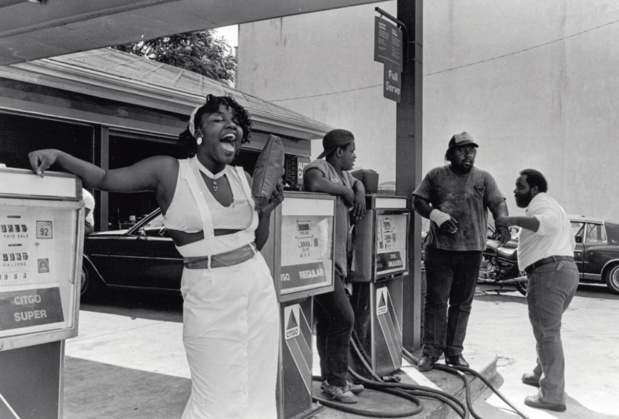
Born in 1953 in Okinawa under US administration, Mao Ishikawa has built a photographic practice rooted in the social and political realities of her homeland. Since the 1970s, she has immersed herself in the daily lives of her subjects—African American soldiers, bar workers near US bases, and marginalized communities—often living alongside them for extended periods. Her landmark series Red Flower (Akabanaa) captures the complex relationships between Okinawan women and American servicemen within a territory shaped by occupation and resistance. Ishikawa resists being labeled an activist, focusing instead on the individual within larger systems of power. Through intimate, unguarded portraits, she reveals how personal lives embody broader histories of sovereignty, race, and identity.
kekahi wahi
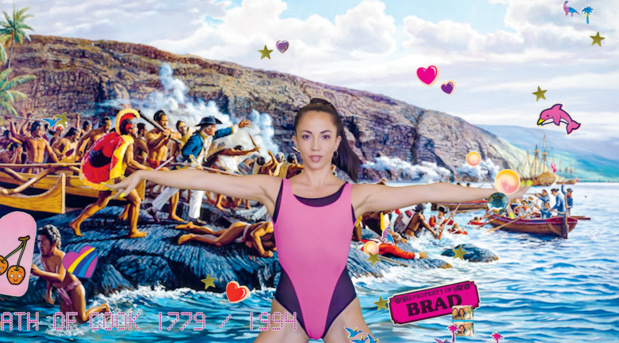
Sancia Miala Shiba Nash and Drew K. Broderick make up the artistic duo kekahi wahi, founded in 2020 in Honolulu and Kona, O’ahu. Their practice explores Hawaiian history, colonial memory, and contemporary narratives through video, sound, and performance, combining humor, irreverence, and experimentation. As they state in their interview, “we try to remain mindful of these earlier documentary efforts while also disrupting the filmmaking conventions that we have inherited.” Works such as 20-minute workout WIP (2023) revisit historical sites, honor queer and cultural resistance, and envision remediated futures. Blending political engagement with playful aesthetics, kekahi wahi reinvents Hawaiian storytelling with joyous, campy, and sometimes unapologetically cringe energy, while paying respect to past generations and the official narratives they inherited.