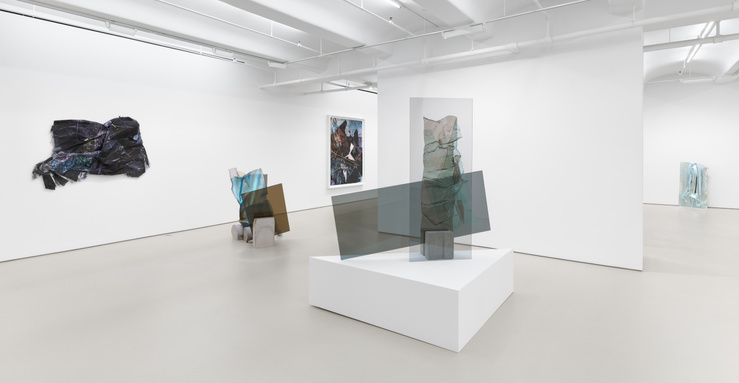
Charisse Pearlina Weston
Between minimalist abstraction and the brutalism of textures, Charisse Pearlina Weston, born in 1988 in the United States, develops a visual language that combines violence, blunt force, and transparent fragility, questioning both the essential nature and the historical scope of transparency. Exhibited this winter at Jack Shainman Gallery in New York, she has also left her mark on Art Basel Miami, where her work was presented by Patron Gallery.
Trained at the University of North Texas and later at the University of California, Irvine, where she earned a master’s degree in fine arts with a focus on critical theory, Charisse Pearlina Weston grew up in Houston, Texas, and now lives in New York. Interweaving autobiographical elements with historical symbols or references drawn from current events, her works recompose, and at times reenact, accidents and encounters in order to offer a poetic perspective whose singularity carries political weight. Moving between two dimensional and three dimensional forms, her exhibitions impose within spatial dimensions a litany of rupture rooted in endured injury. Like a variation on the passions, understood as an external attraction capable of altering even our most intimate behavior, forms are shattered into desirable ensembles.
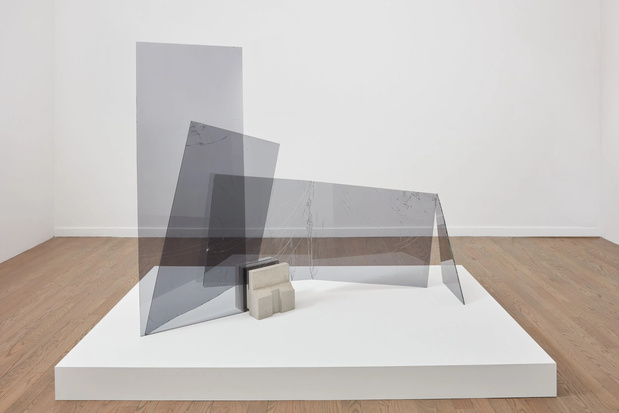
Grounded in her reading of power relations and discrimination directed at the Black American population, the artist alters the forms of glass, renders surfaces opaque through fire and distortion, and gives form to the multiple dimensions and layers of a reality fractured in countless ways. Yet within this labyrinth without exit, within these vanishing lines without escape, a constellation of questions surfaces and a troubling quietude emerges. Is this the spectacle of a completed violence, the condition of appeasement through acceptance of the accident? The possibility of a non linear narrative that nonetheless unfolds through independent lines whose tragic convergence always leads to the event, in what it carries of both predictability and chance? The titles of her works, akin to literary digressions of suspended feeling, return us to liminal spaces whose nature oscillates between a state and a state of mind.
If everything in her practice begins with drawing, form giving, construction, and assembly participate in this uncertainty, blurring intention so that only its trace remains. The infinitely coherent essence of this work, with its undeniable formal efficacy, allows itself to be shaped by the dynamics of a reality whose terrible unpredictability it renders palpable.
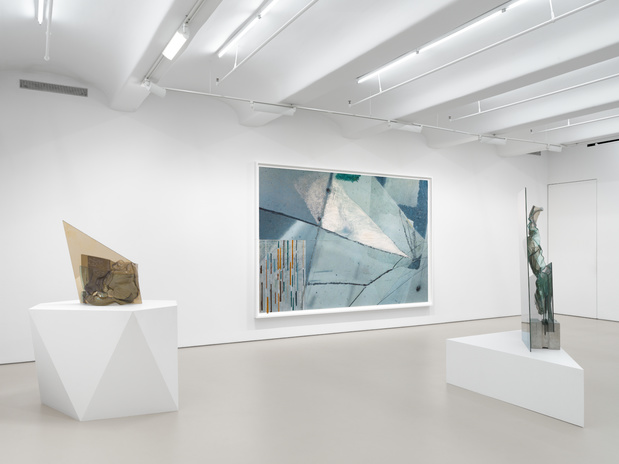
A constant movement, a continuous transformation, emphasized through an exploration of repetition and reprise, understood in the musical sense of the term cover, the plastic composition establishes correspondences between works and the spaces they inhabit, tracing lines that function as parallel tracks of interwoven rhythms and cadences. This rhythm is that of a spectacle weary of yet another repetition, that of injustice and suffering, which the artist seeks only to render materially through intrusion, via the sometimes fleeting impression of archival traces impressed onto her structures. Sheets of glass, even when immaculate, articulate the impenetrable opacity of fact in relation to the gaze that confronts it. Is this once again the reason for the artist’s withdrawal from current events and their reflection across social media platforms?
On the occasion of her most recent exhibition at Jack Shainman Gallery in New York, the artist published a manifesto text diagnosing an illusion nourished by the reflection of a media world over which everyone believes they hold some degree of control. It also references the Lacanian theory of systematic misrecognition, invoked in the exhibition’s title, which undermines the cognitive bias of an altered recognition of oneself as another, or of another as that which once bound itself to the self. The use of safety glass and its multiple transformations contributes to a semantic polyphony. The material protects only those who already possess the tools of production and grants visibility only to those who position themselves on the so called right side. It is precisely through detachment from this troubled world that Charisse Pearlina Weston manages to extract what still moves within a living, non connected version of her consciousness.
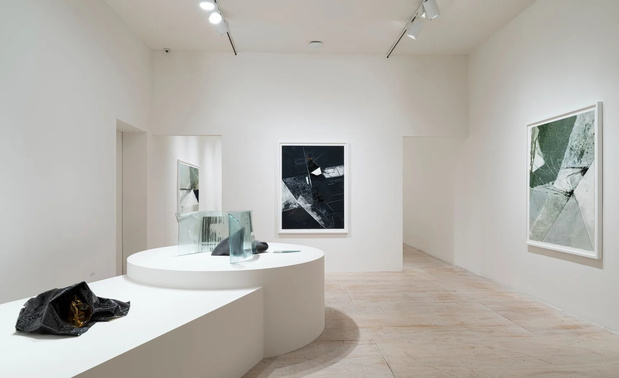
What is essential here lies in the altered perception of a reality materialized by glass that separates more than it protects, a deterioration of the harmony of constructions and human relations that is internalized and rendered systemic in the gaze of those who endure oppression because of the very qualities of their bodies. There persist, like a retinal afterimage, the stigmas of a gaze condemned to turn away, to draw sustenance from cracks in the ground, from horizontal cuts in anonymous buildings, anchoring points with which to resist the dynamic of provocation carried by the gaze of others ready to exert their domination. Each deviation becomes a victory, a reconstruction through deforming pressure, once again echoing the squeeze of the title, of an element that, while uncertain, imposes its singularity within the landscape. Amplified by the prefixes mis and mé, which impose a drift, the ambiguity of inflection adds a visceral vertigo. Even while recognizing the force of a distortion of reality, its victims, and others as well, collapse into the trap of acceptance, adapting their desire to this empire of sand.
And behind the highly desirable beauty of the artist’s constructions, this threat weighs heavily, demanding a fundamental reconsideration. The harshness and violence of our representations, as well as those imposed upon us, very real indeed, rest on foundations that betray their own fragility and inconsistency, caught within a security driven delirium and a desire for salvation that confuses protection with confinement. Protection of the self and confinement of others, protection of others and confinement of the self, an adage whose circular logic reflects, if left unbroken, the tragic advent of self destruction.
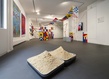
Charisse Pearlina Weston, mis and mé (squeeze), exhibition at Jack Shainman Gallery, 513 West 20th Street, New York, from October 30 to December 20, 2025.