Ibrahim Mahama — Fondation Cartier, Paris
At the Fondation Cartier, Ibrahim Mahama presents The Harvest Season, an exhibition that is as collective as it is personal, bringing together industrial memory, colonial legacies and visions of the future. Joined by nine artists and collectives, the Ghanaian artist orchestrates a journey through histories and geographies in which artworks displace narratives, redistribute legacies and question the very conditions of exhibition-making. An ambitious proposition in which the intelligence of resonances, the essential force of artistic creation and the power of forms prevail over the spectacular, and even over the spectacle one might expect.
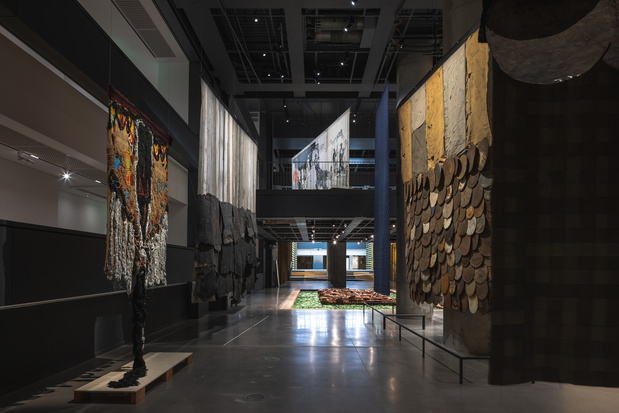
And this is precisely what he applies to all his forms of creation, making it his mission to entrust objects to the public so that viewers may make them their own and expand their boundaries, with the avowed aim of “excavating elements from the past in order to invent a better future”.
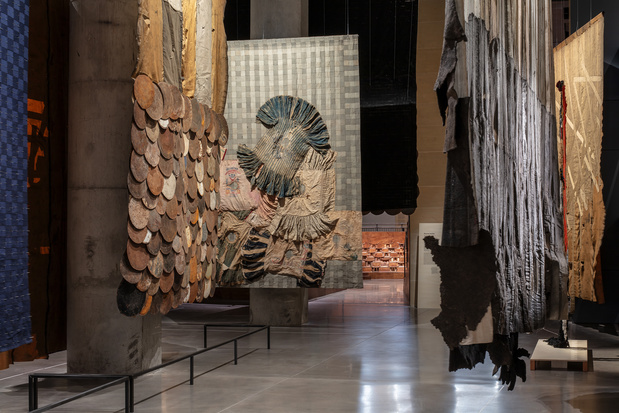
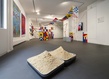
With this ambitious undertaking, Ibrahim Mahama puts his founding principles into practice through a collective presentation in which the dozen or so invited artists and their works allow perspectives, techniques and temporalities to circulate through disruptions of our perception that redraw the boundaries of the worlds and representations we inhabit. While emotion and a sense of estrangement from the principle of reality run throughout the works, it is above all the intelligence of their dialogue, in all their specificities and singularities, that gives this exhibition its full strength. It is as ambitious as it is tightly focused on genuinely distinctive artistic perspectives, and it deftly inhabits the Fondation’s complex spaces, where volumes ranging from the monumental to the minuscule coexist and sometimes jostle against one another. This intelligence first and foremost offers an overview of Ibrahim Mahama’s work, which Paris is discovering for the first time on such a scale, revealing itself, in all its plurality, as capable of encompassing an inventive spectrum that is as broad as it is polyphonic. Rich in a confidently asserted identity and bearing witness to constant inventiveness, his works embody the dual dynamics of affirmation and concealment.
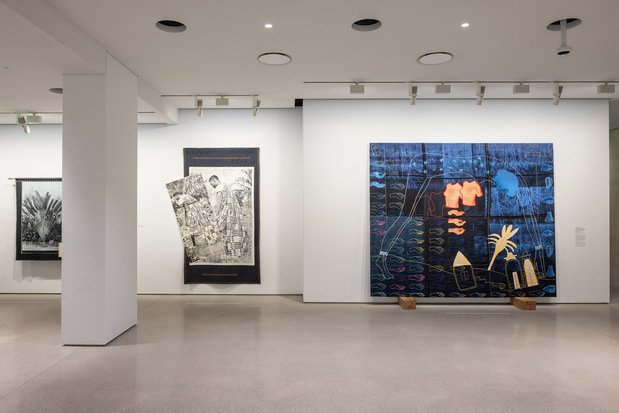
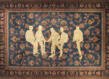
From the subtlety of his readymades to the reinvention of existing structures, from fantastical hangings that carry within them the age-old gestures of craftspeople and their art of adapting to an industry that threatens them, each creation seems to stand on the fine line of a visual expression of history, dressing the walls they occupy without ever seeking to erase them, even playing on this very notion of “hospitality” to turn historical hierarchies on their head. Only the paintings, marked by a symbolism tending towards idealisation, can counterbalance the power of this ensemble, which could perhaps even move with ease towards greater radicality by further stripping away traces and signs, so strong are its underlying ideas and methods.
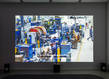
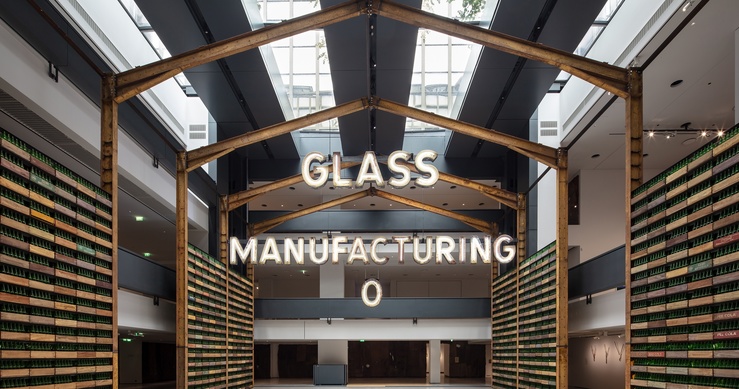
So strong, indeed, that they go beyond the restraint displayed by the artist himself, whose vision confronts conflicts without reigniting them, to address the contradictions of a luxury foundation opportunely situated in the Palais-Royal. The grandeur of a brand-new building in the heart of historic Paris is aptly unsettled by the arresting sight of the skeleton of a glass factory transplanted into this seat of power, which turns it into a sarcophagus whose irony is far from ineffectual. The celebrations of the powerful silently sink into the coffin of a consumer industry whose roots have been nourished by their appetite for wealth. Which of the two, then, bears the burden of exploitation?
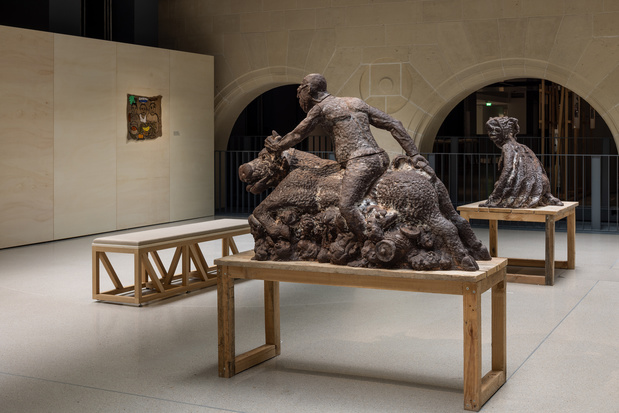
The question remains entirely open, and its merit lies precisely in being raised. It runs through all the interventions that punctuate a journey giving considerable space to other artists, with enough latitude to present several works and offer a fair overview of their practices. For these distinguished guests, each of whose contributions could constitute an exhibition in its own right, such is the seriousness of the curatorial vision developed by the artist and his teams, the conditions of display, ranging from the extraordinary to the indecent, will remain open to debate. This time, however, the artists are, on the whole, treated with respect. One is thus delighted by remarkable works by Zohra Opoku and Gideon Appah, the highly subtle and no less fascinating multifaceted approach of Feda Wardak, the welcome inventiveness of Tjasa Rener and Courage Dzidula Kpodo, and the historical richness of Dorothy Akpene Amenuke and James Barnor, before concluding on a high note with the Cercle d’art des travailleurs des plantations congolaises.
The overall impression is one of considerable richness, ultimately shaping an anti-spectacular spectacle capable of subverting the very conditions of its own expectations, and perhaps even those of its custodians, to the great delight of visitors who find themselves mesmerised by the relentless momentum of an artistic creation that necessarily and continually calls into question the conditions of its emergence and the contexts in which it is presented.