Faire place au monde — Cité internationale des arts de Paris
With Faire place au monde, the Cité Internationale des Arts in Paris presents a wonderfully eclectic exhibition that succeeds in balancing its own ambitions, rooted in the heterogeneity of its material: the international artistic creation it nurtures every day.
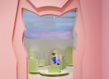
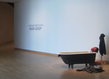
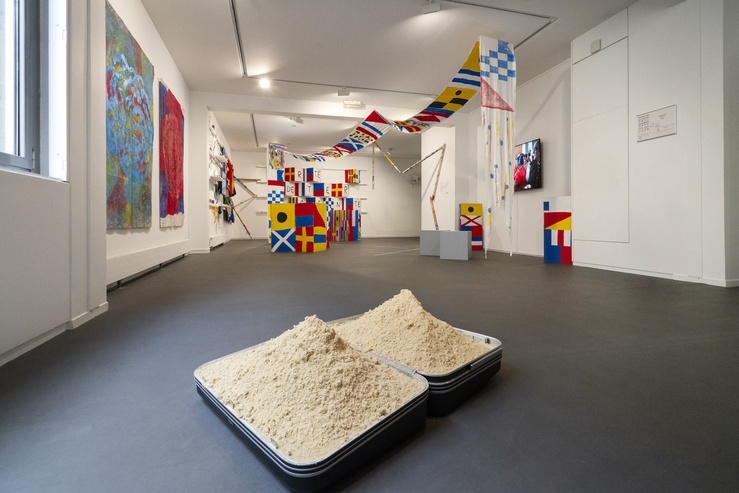
Faire place au monde @ Cité internationale des Arts from October 8, 2026 to January 16, 2027. Learn more In keeping with this spirit, the works open up as many doors onto singular journeys as they embrace a shared ambition: to bring to life feelings and visions of territories, whether inhabited, left behind or dreamed of, that can profoundly nourish our imaginations. Making playful use of the building’s starkness, the exhibition design takes risks and celebrates artistic forms in which the organic, the accidental and the curved extend the sharp angles of shared forms of expression. Hussein Nassereddine’s poetry, serving as a kind of prelude, places us in an in between space whose tranquillity carries the tragedies of shared memories. It definitively untangles the apparent certainties of history and geography, inviting us to consider each place as a source of feelings and, therefore, of dynamic realities. This principle is taken up in turn by Taysir Batniji, who places a suitcase on the floor, weighted with a terribly symbolic burden: the land it allows us to leave behind.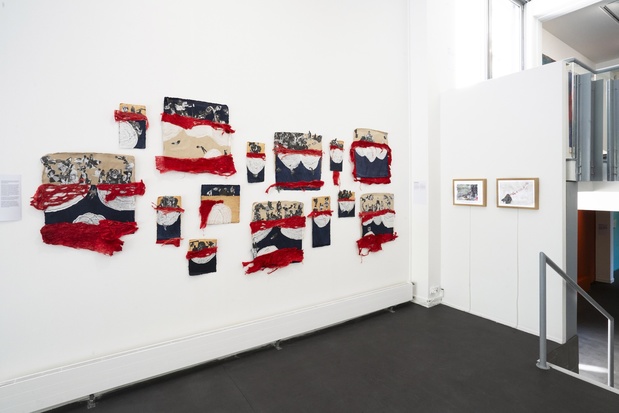
On the walls, he evokes another kind of impasse by displaying a screenshot from a phone as images are being downloaded. Captured during the intense bombardment of Gaza by the Israeli army, these images embody the void in which the artist remains suspended during each moment of waiting, an uncertainty that unsettles even his own sense of reason, stripped of the ground beneath his feet. The lines are no more stable in Wendie Zahibo’s work, where layers of floating landscapes bring together existing lands and myths that echo fragments of reality.
The interventions of Zbinek Baladran, who places works by former residents of the Cité on freshly repainted exhibition walls, further unsettle the expected order. An imaginary exhibition within the exhibition, it dismantles any possibility of hierarchy or verticality by disrupting the very workings of authority. Thoughts and forms collide here, bringing other ghosts to life.
Ghosts also find their way into Louidgi Beltrame’s work through the striking juxtaposition of his video Energodar, made in 2010, a hypnotic journey into the heart of Ukrainian nuclear cities, and Katashima Torpedo Base, a static immersion in a Japanese military building. Here, the poetic melancholy of Kino, an emblematic Soviet rock band whose music is as disillusioned as it is full of promise, sets the rhythm for a confrontation whose historical weight connects continents, placing them on a fertile horizon of thought.
This spectral vision, finally, could just as well concern the living and express the very bond that unites them, one destined to endure beyond the contingencies of the body and gender. This is perhaps the case with Young Joo Lee, whose work explores lineage from mother to child, examining the maternal condition and its forms of resistance in a world that compels women to invent their own ways of giving it material form. Her map of the world, constructed from a maternity sheet and dressed in fabrics from men’s suits, is a remarkable illustration of the transformative power of borders and of spaces that can be inhabited and clothed differently.
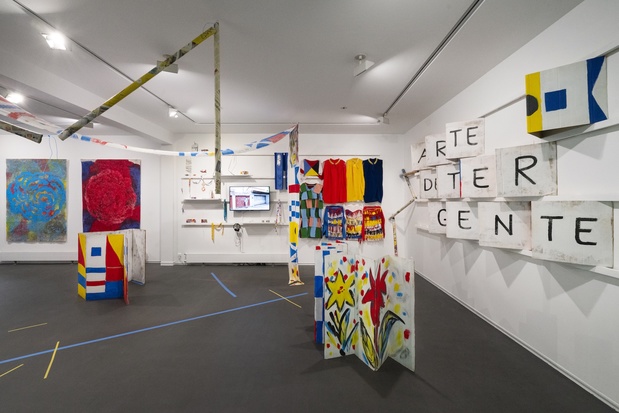
For this exhibition is concerned as much with energy as with form, with artistic invention and the use of materials and signs that celebrate horizontality, a level plane of thought that connects different layers, those belonging to the artists’ past and those belonging to the present of artistic creation, while also sustaining a field of projection, a horizon that nourishes the imagination. This sense of gravity is what gives the exhibition its coherence and so effectively reflects the intelligence of an institution that makes the heterogeneity of artistic practices and the histories running through them the very material from which its exhibition design takes shape.
Remaining faithful to its commitment to placing the practices of internationally renowned artists and those of the most discreet practitioners on an equal footing, the exhibition brings into dialogue works that resonate or clash, assert their presence and make a case for the future, or slip into the interstices of memory in order to work upon it.