Ymane Chabi-Gara — Galerie Mennour
At Galerie Mennour, Ymane Chabi-Gara presents an exhibition that feels at once restless and dreamlike. Images collide and intertwine, revealing beneath the apparent calm of deserted interiors a landscape of diffuse emotions and a painterly practice that constantly tests its own possibilities through variation and transformation.
This sense of ambiguity lies at the heart of Chabi-Gara’s work. Her paintings are deeply narrative and emotionally charged, using intimate spaces as a way to explore solitude, memory, and the complex relationship between self and other. Drawing on photographs, personal recollections, cinema, and music, she creates worlds that appear familiar yet remain subtly unstable. Silent rooms and suspended figures inhabit these scenes, caught somewhere between presence and absence. Dense compositions multiply perspectives, details, and shifts in scale, encouraging viewers to wander through the image rather than grasp it all at once.
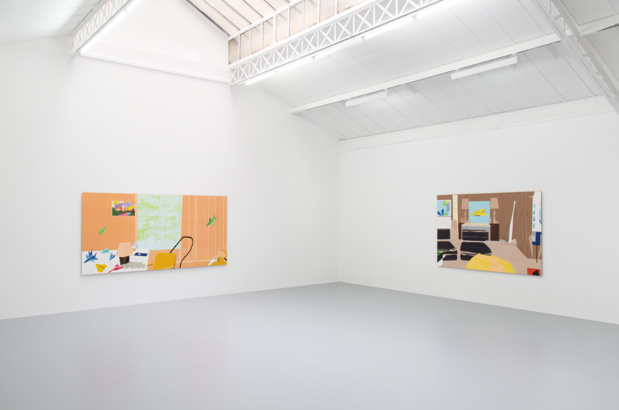
Throughout her work, control exists alongside surrender, order alongside disorder, surface alongside depth. Forms emerge like fragments of memory in motion, while shifts in texture and bold contrasts of colour create spaces that are both physical and psychological. Through meticulous attention to composition and materiality, every object and motif acquires an almost organic presence, contributing to an emotionally charged reinvention of reality.
Continuing her ongoing reflection on intimacy and the social pressures exerted on the body, Chabi-Gara turns in this exhibition to fiction, and particularly cinema, as a catalyst for new formal and material explorations. Borrowing its title from a line in Gregg Araki’s film Mysterious Skin, the exhibition remains close to anxiety and vulnerability, exploring both the fragility of inner lives and the beauty of the visions they produce. If the home has often functioned in her work as both refuge and witness to a form of existential withdrawal, it becomes here the stage for another kind of confinement, one rooted in family structures and inherited tensions.
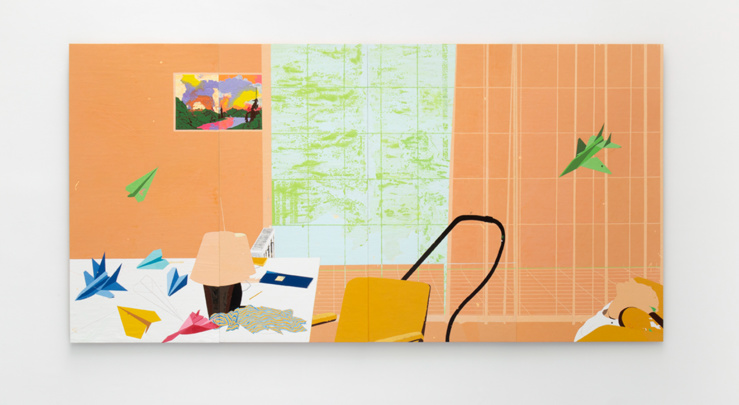
A sense of threat hangs over the exhibition without ever being explicitly defined. It appears in the form of origami warplanes, fragile outlets for competing fantasies and desires. At once playful and unsettling, these paper aircraft evoke invention and violence, imagination and authority. Their sharp folds echo the angular architecture of houses, the hard diagonals of furniture, and the objects scattered throughout these pale interiors. Lines seem less concerned with defining space than with constraining it. They overlap and accumulate, creating zones of friction where the environment appears to close in on itself.
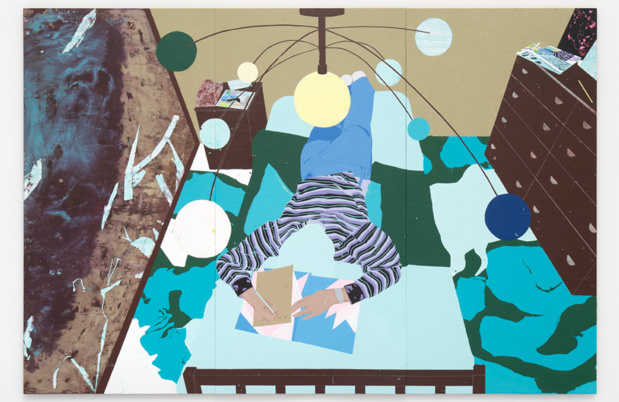
The domestic interior becomes more than a setting. It serves as the starting point for possible narratives, a place where lives unfold between memory, fiction, and projection. The figures inhabiting these works drift between dreaminess and disorientation, between vigilance and surrender. At times they appear almost absent, at others intensely present, suspended in states of uncertainty that mirror the unstable emotional terrain of the paintings themselves. One of the exhibition’s greatest strengths lies in Chabi-Gara’s remarkable sense of composition. Visual motifs echo from one work to another, crossing formats and media. Drawings and painted images seem to escape their frames only to reappear elsewhere in the gallery, reincarnated in new forms. This deliberate disruption of coherence creates a strangely immersive experience. Meaning emerges not through linear narratives but through a dreamlike circulation of images that return, shift, and transform. The result is an atmosphere of quiet intensity in which the physical power of the paintings expands beyond the canvas and gradually absorbs the viewer.
As we move through the exhibition, areas of fullness and emptiness establish a rhythm that mirrors the slow maturation of the paintings themselves. Ghostly presences emerge from these spaces, uncertain whether they represent absence, distraction, memory, or emotional reversal. Chabi-Gara introduces outward perspectives into her landscapes, yet they always remain filtered through an intensely subjective lens.
Chaos sits beside order, emotion beside discipline, instinct beside mastery. This tension can be seen in works such as Brian’s Room, where a turbulent vortex occupies the same space as the carpet of a man quietly absorbed in reading. Such juxtapositions reveal the artist’s ability to tame competing visions and move seamlessly between the depths of imagination and the blunt force of reality. A painting may lead us from psychological turmoil to the simple pleasure of following a precise line of paint across the surface.
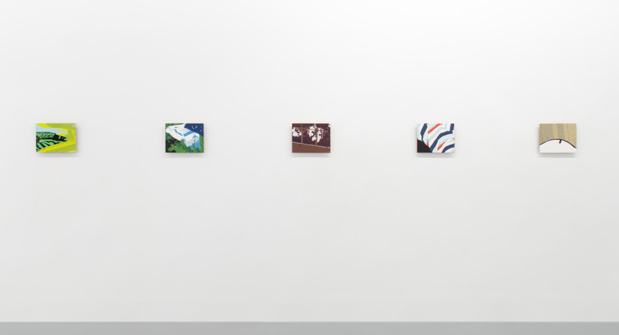
Cinema, music, literature, and illustration all find a place within these works. Emotional expression, storytelling, observation, and psychological reflection coexist without hierarchy. Rather than resolving contradictions, Chabi-Gara allows them to remain active within the image. Opposing modes of representation challenge and reinforce one another, producing a body of work that captures something essential about contemporary experience: a consciousness navigating a world whose only certainty may be its vertiginous instability.