June Crespo — Crédac, Ivry-sur-Seine
June Crespo, a Spanish artist born in 1982, whose intriguing sculptures merging the organic with the mechanical we were able to discover at the 2022 Venice Biennale, presents her first exhibition in France at the Crédac, Rose Trrraction.
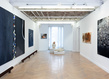
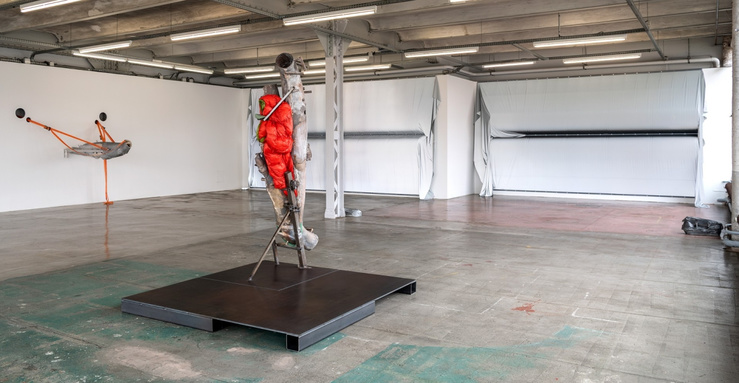
June Crespo — Rose Trraction @ Le Crédac, Centre d’art contemporain d’Ivry from September 21 to December 14, 2025. Learn more Echoing its title, with the intensity of a language she wants to strike the French ear and associating nature with mechanical force, color with gesture, she unveils a fascinating procession of synthetic creatures whose bodies, damaged, hammered, and patched together, offer themselves to the gaze as astonishing witnesses of a parallel, accident-ridden life, sometimes still strained toward an uncertain future. Facing them, shrouds protect cold tubular structures with their sensual softness. Heat and cold, hardness and softness compose a path filled with an ambiguous sensuality. Between procession, funeral display, and laboratory immersion, the accumulation of signs invites the imagination to cross boundaries.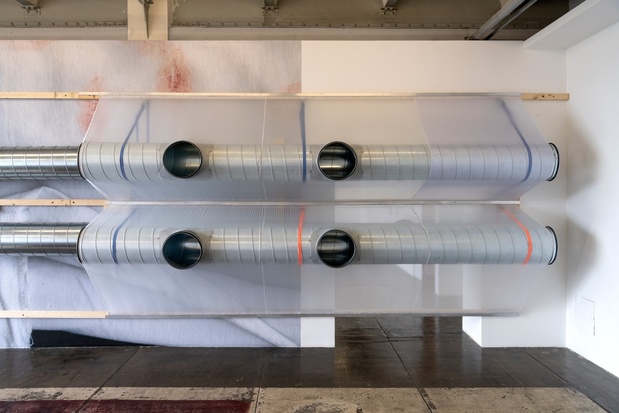
All kinds of materials meet there, blurring the lines between the functionality of a tool and its proximity to our humanity. For one senses clearly, faced with the multitude and diversity of gestures that presided over their creation, that it is first through sensitivity, through touch, that transformation and generation come together here, tracing in the exhibition space a set of inflection lines guiding the gaze from one material to another in a secret choreography.
Continuing the vibrant tradition of Basque sculpture embodied in the second half of the twentieth century by figures such as Julio González or Eduardo Chillida and their use of iron and steel, Crespo’s work nevertheless manages to infuse it with a singular intensity. Spinning a thread in which discreet narratives combine with biographical incursions that serve as conceptual landmarks, the initial formalism of her universe unfolds into a story of materials, gestures, and affects grounded in the notion of touch, whether allowed or forbidden, whether it soothes or threatens.
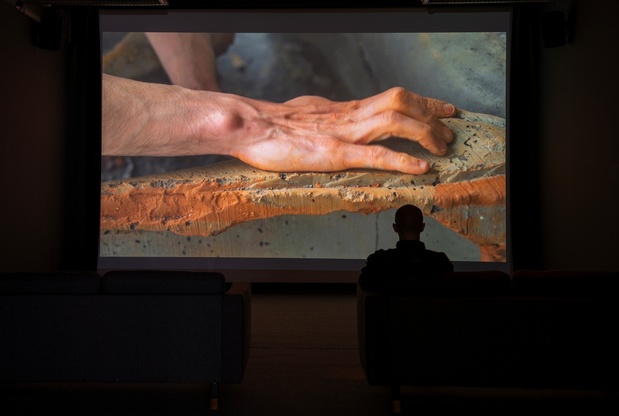
This synthesis can be found in the beautiful film shown alongside the exhibition, capturing the moment of encounter between the hand and the work, a reversed process in which creative thought seems to reside entirely in the way of caressing and meeting matter.
It is a striking analogy that conveys the full power of this immersive work rooted in organic desire, in the pleasure of rendering the suppleness, plasticity, and hardness of the material, as well as the negative presence of emptiness. It conceives sculpture as a way of familiarizing oneself with matter rather than taming it, of allowing oneself to be inwardly carried by what it provokes rather than transforming it.