Sarah Grilo — Galerie Lelong
A major figure of abstract painting who passed away in 2007, whose intense and subtle works inhabit the great collections of modern art, Sarah Grilo continues to weigh upon contemporary history alongside the greatest artists.
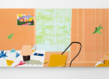
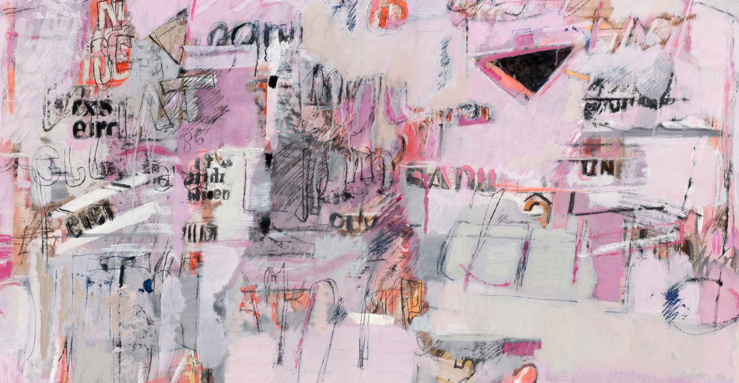
Sarah Grilo — Paris — Madrid @ Lelong & Co Gallery from January 15 to March 7. Learn more In its Paris space, Lelong Gallery, which have presented in New York in 2024 an exhibition of her work that caused a sensation pursues its salutary endeavor of bringing renewed attention to an artist radical in her approach, whose motifs, letters, numbers, and fragments compose landscapes with poetic, brutalist resonances, where colors are carried along in blocks that are more sensorial than abstract. This presentation comes at a moment when the artist’s intense painting seems finally to align with the tempo of history. Marked by architectural modernity and its semiotic charge, Grilo’s work plays with the upheaval of urban perspectives, reinventing visions that are so many attempts to capture their essence. Her works thus weave a link between the innovative spirit of Cubism and the American avant-garde she embraced.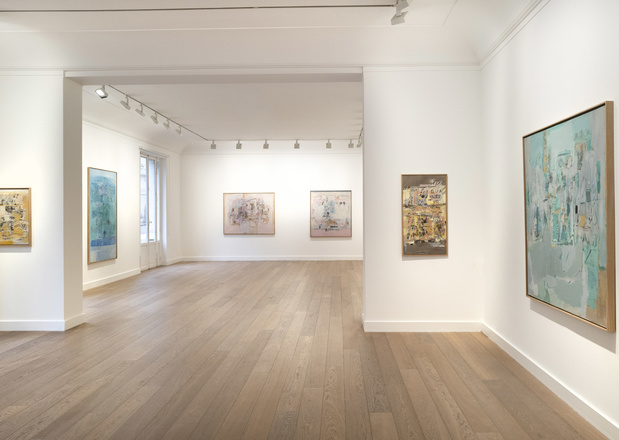
Born in Buenos Aires in 1917, moving from figuration to abstract constructions, Grilo never ceased to shift her gaze, whether in terms of influences or perspectives. Argentina first, Paris in the 1950s, New York from 1962 onward, then Spain, Madrid, from where a dialogue unfolds with her experience, with her roots planted between Argentina and Paris. An atlas of complex lines that might, in a sense, echo the richness and the process of elaboration by contamination found in the works presented here, where the surface—traversed by signs, erasures, back-and-forth movements—is like land redrawn as it is walked upon. Architecture reveals itself on and beneath the planes of color that sketch the reliefs of compositions emerging from the center of the canvas. Each thus constitutes a paradigmatic construction of an object whose act and nature (the invention of a script, the elaboration of a landscape, the making of an image, the conception of a plan, the translation of an emotion) remain an enigma, and perhaps even a game—one that resounds and cracks like a world under reconstruction, restless beneath her feet.
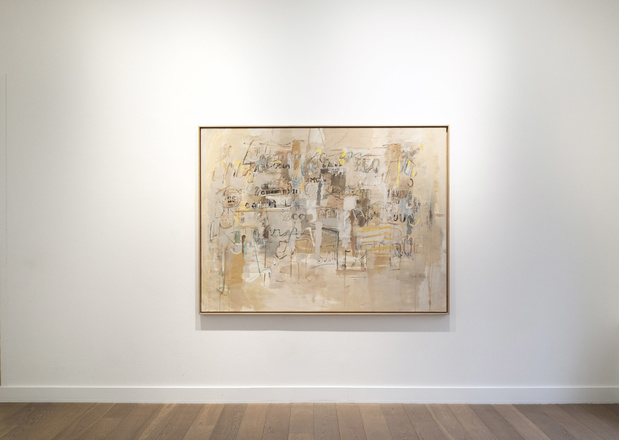
Extremely compelling, this highly coherent body of work, centered on the 1970s and 1980s, conveys the maturity of a gesture that nonetheless loses nothing of its experimental drive. Each painting seems to foreshadow a movement and to proceed along the path of a formal inquiry that vibrates with choices and discoveries the eye takes pleasure in identifying, constantly passing through relationships and games of balance between ever-renewed lines and forms. From its own constraints emerge orders, and from its accidents, structures are erected.
In many respects, this painting embraces the culture of a postwar era engaged in the reinvention of the foundations of a world that has failed; from the fragmentation of its signs arise above all the principles of a poetics of gesture, where writing, landscape, image, architecture, and emotion intertwine in a whirlwind that each canvas attempts, in its own way, to circumscribe.