Felicità 2025 — Qui sont les Félicités des Beaux-Arts de Paris ?
Felicità 2025 brings together the 24 artists who graduated in 2025 from the École des Beaux-Arts de Paris with highest honors.
Mehdi Boualli
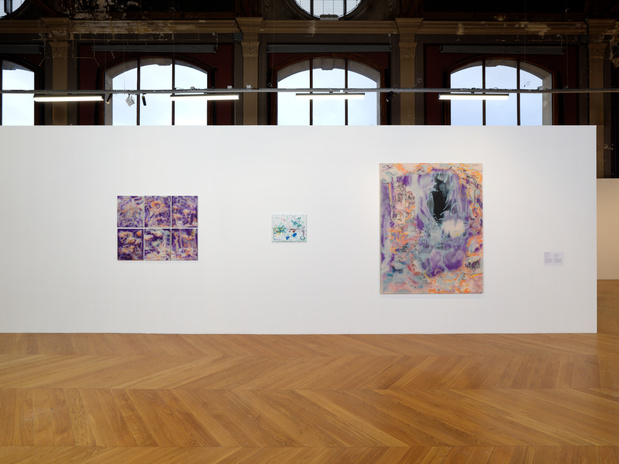
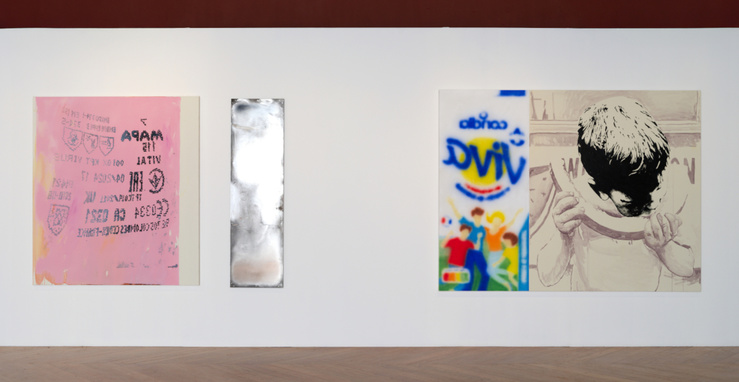
Mehdi Boualli develops a form of painting crossed by multiple references, rendered unstable through the use of the airbrush. Between figuration and abstraction, he constructs images close to chaotic landscapes, often nourished by worlds drawn from video games and dark fantasy that go beyond the monotony of digital rendering by infusing it with the dynamism of framing. An intriguing energy modulates these works to the point of making each variation the driving force of a succession of visual explosions, each composition traversed by quasi semiotic bubbles.
Sila Candansayar
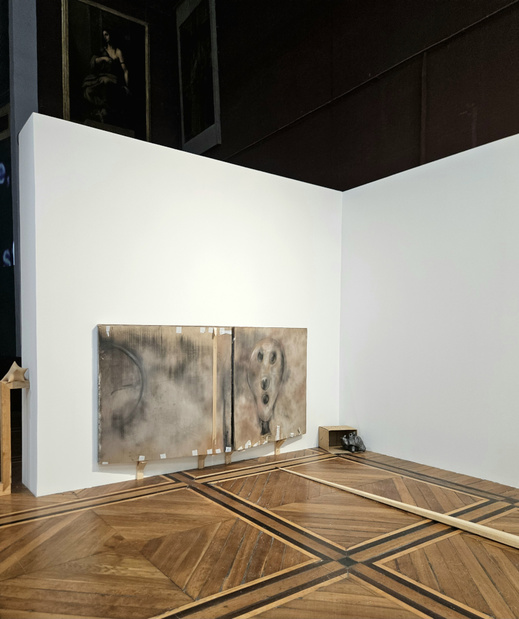
Sila Candansayar’s work explores a singular vocabulary of signs and gestures which, when deployed in space, unfold dizzying narratives where styles and modes of attention intertwine. Her sculptures combine fragmented bodies and materials to convey sensitive mental states, open to the multiplicity of registers that contemporary consciousness navigates on a daily basis. Between meticulousness and spontaneity, they give form to a thought in motion.
Virgile Desbat
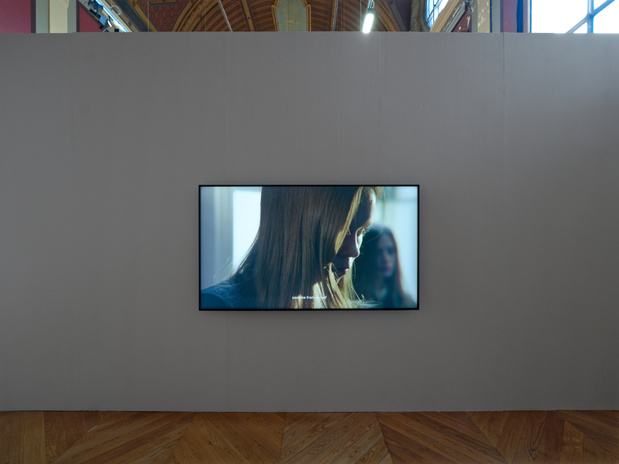
Revisiting the codes of the teen film through a concise cinematic writing rich in references to popular culture, Virgile Desbat diverts the stakes of comedy in order to invent an alternative language of drama. By keeping violence off screen, he gives concrete reality to the necessarily fragmented perception of manipulation and control, an insidious reflection of a collective imagination grafted onto codes that blind it.
Ladji Diaby
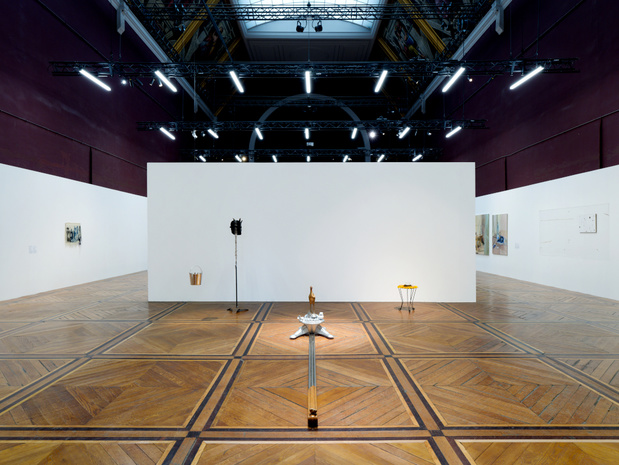
From abandonment to sacralization, Ladji Diaby composes installations from found objects, assembled into forms with an almost ritual dimension. Through the precision of his associations, he transforms scattered elements into devices charged with poetry, at the intersection of the spiritual and the political. The modified object becomes the vehicle of an imagination that absorbs it and carries it into a possible reconstruction of the structures of the world through singular monuments, human in scale and anchored in our present, named by a simple date, perhaps that of their entry into his own time. G.B.
James Dosa
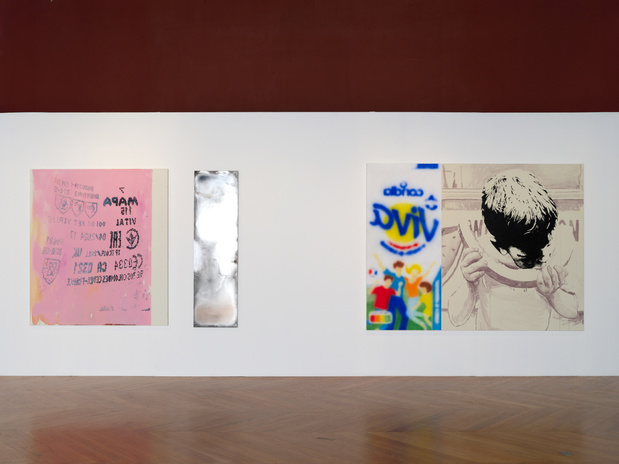
Through the montage of images drawn from popular culture, James Dosa questions family norms and models of masculinity. In juxtapositions of striking effectiveness, he confronts focal lengths and genres with moments of observation at the scale of childhood. Signs become icons and norms, once broken, are rebuilt through their stigmas, making fragility or even lack a space of possible transformation. G.B.
Marine Ducroux Gazio
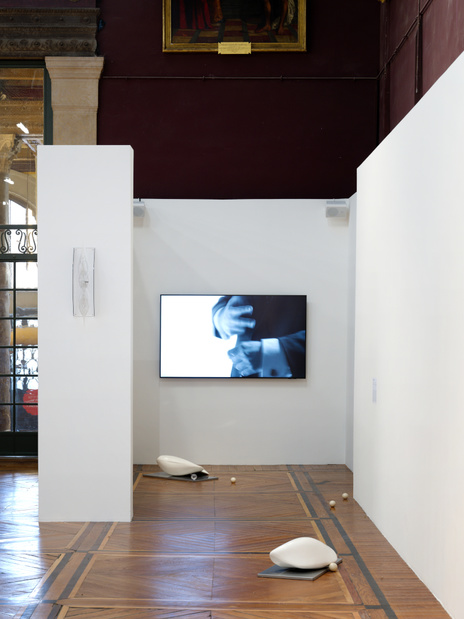
From the absence of roughness to the deceptive staging of waiting, Marine Ducroux Gazio establishes situations of suspended time made of repetition and slippage, whose meaning to be invented passes through the accumulation of doubt. Her work questions belief, illusion and our own perception of change in a world whose very principles of the flow of time she calls into question.
Yann Fonseca Rodrigues
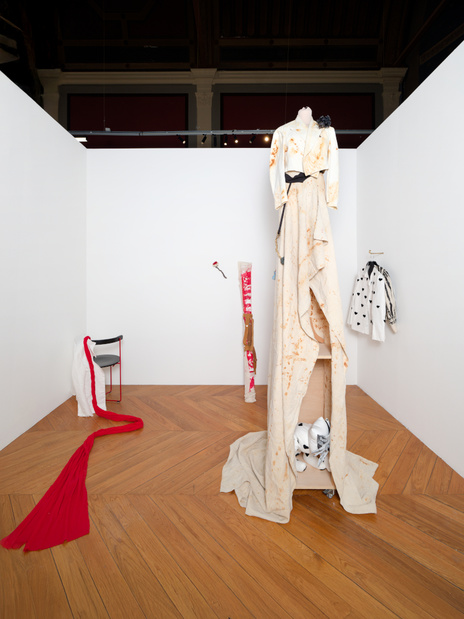
Yann Fonseca Rodrigues blurs the boundaries between art, fashion, performance and even the practice of exhibition itself. By transforming paintings and sculptures into garments or accessories, he creates works to be activated through discreet situations in which bodies participate in the progressive construction of images nourished by new causalities, those of his work.
Helena Fourmont
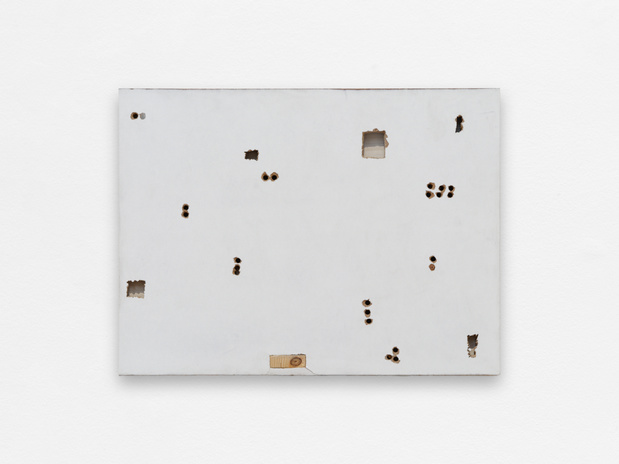
Through subtraction and in negative, Helena Fourmont works with industrial materials brought back to their nature as medium. Following the signs present in wood, she brings forth complex surfaces evoking mineral structures or labyrinths, extending this gesture into the exhibition space itself. Of striking philosophical scope, her holes that lead nowhere reverse the very notion of progression by revealing the emptiness of its back worlds. Dug out and excavated, the act of exhibiting becomes a total commitment and creates an entire space with no escape. G.B.
Cléopatra Gones
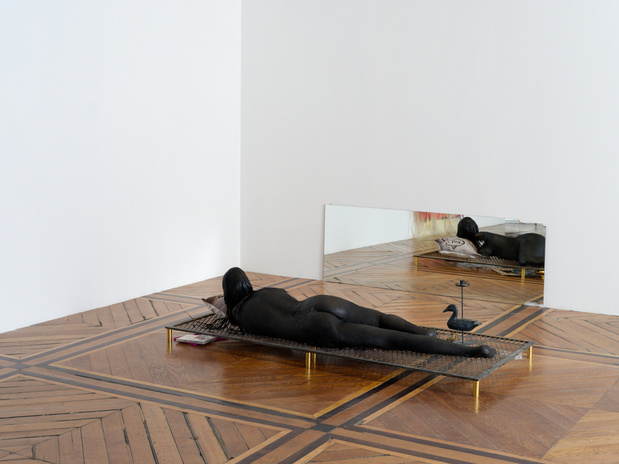
Through assemblage and collage installations, Cléopatra Gones questions colonial inheritances and their contemporary persistence by composing unsettling stagings in which bodies are traversed by signs whose contradictions refer back to history. By diverting objects linked to care and beauty, she fragments normative representations of Black femininity in order to address the complexity of an emancipation whose ambiguity between power and seduction constitutes its driving force. G.B.
Hugo Hectus
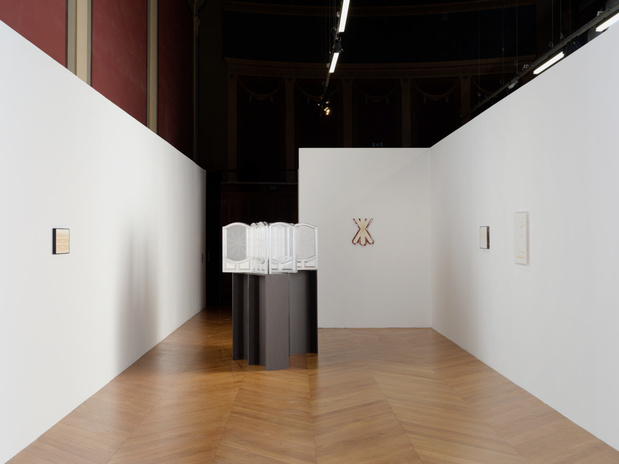
The sculptural objects of Hugo Hectus treat language as a malleable material, deprived of immediate meaning yet participating in a defined material structure. His installations summon letters without words that evade their inscription within the exhibition field and maintain a tension that engages the viewer in an active relationship with the work. One that it resolves only partially, preserving a mystery that refers to the spaces we inhabit, riddled with signs and urban signatures that have become architectures of our imagination.
Sanggu Kim
While he artificially induces the aging of paper through the controlled use of light, Sanggu Kim focuses on the doubt maintained by the youth of rapidly developing technologies. His work, nourished by quantum physics, observes the effects of time and acceleration, proposing a sensitive attention to the present, which becomes both an object of experimentation and a subject of reflection.
Arya K /Nell
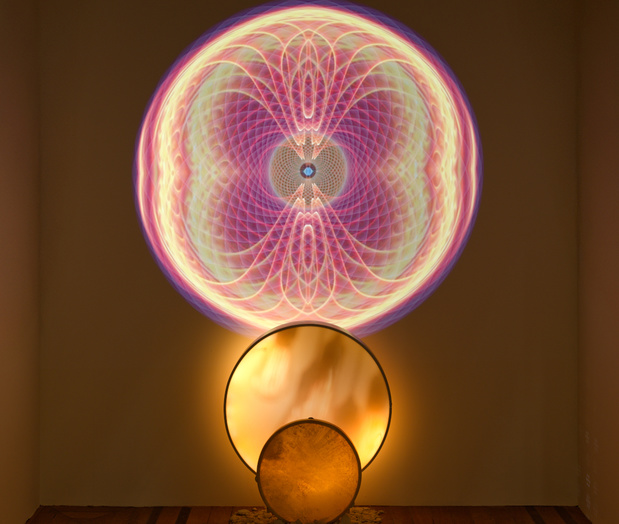
The pagan altar erected in the darkness by Arya K Nell marks the exhibition with its undeniable plastic force. Developing installations and performances around transformation and reconstruction, she conceives a body of work that navigates between homage to pre existing entities and a present already fading into the darkness of its rage. An aesthetic of collision that resembles a final review of a world whose images themselves disappear behind the clamor of its collapse. Perhaps moving toward a collective rebirth. G.B.
Adrien Lagrange
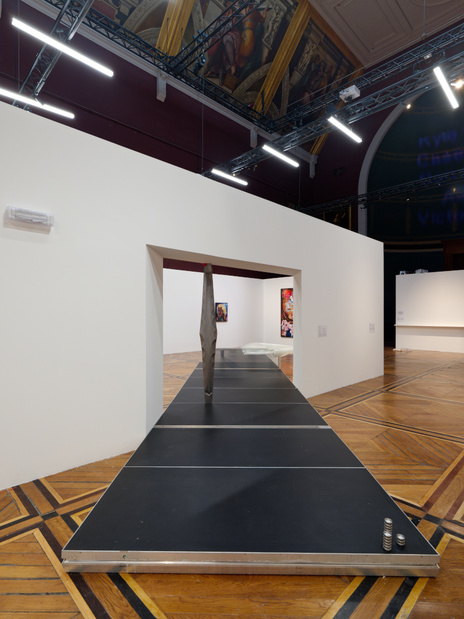
Exploring the discreet violence of contemporary spaces through sculpture and installation, Adrien Lagrange stages an enigmatic device of undefined status. An architectural space reduced to brutality, his work becomes a support to the point of allowing its supported nature to show through, validated solely by the exhibition context that confirms its functionality. By placing urban architectural clues and minimalism in tension, he opens a reflection on the social projects of the twentieth century and their formalism, insidiously internalized even within the bodies of those who inhabit them.
Ibrahim Meïté Sikely
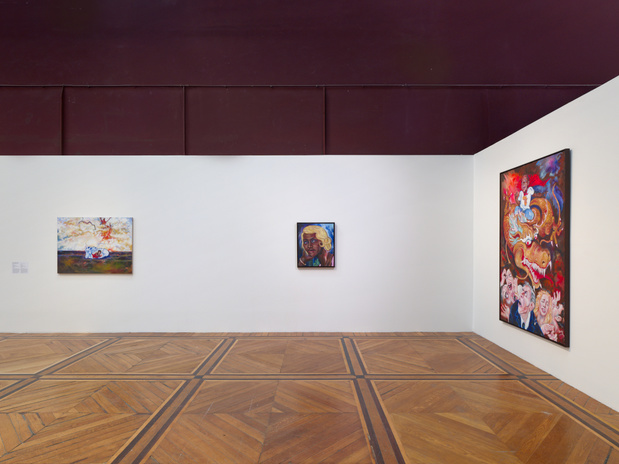
Ibrahim Meïté Sikely claims a turbulent painting whose spectacular dimension largely arises from a pantheonic approach to his surroundings and his intimacy. Naivety and the grotesque punctuate the temporalities of composition in which signs, perceptible or secret, recombine into a coded painting far removed from traditional systems of cultural domination. Without excluding icons, his painting thus offers each time a joyful or instructive allegory of the subjects he takes on.
Winca Mendy
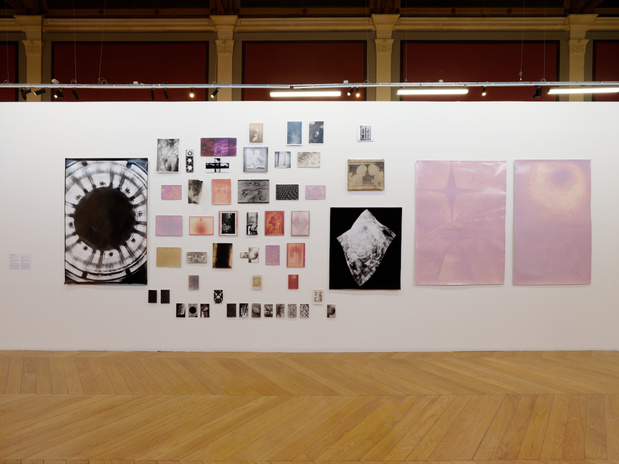
Through a succession of archival aesthetics, Winca Mendy produces images that comb through history in an attempt to capture invisible or silent forces. In dialogue with contemporary algorithmic logics and emancipatory reflections, he uses the photographic lexicon to formulate a deeply personal vision of these new circulations of power, infusing them with his own personality, beliefs and the lingering traces of mythologies that extend their echo.
Salomé Moindjie Gallet
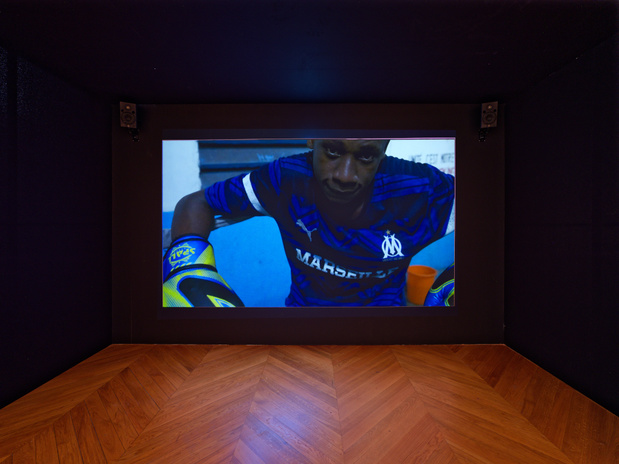
Salomé Moindjie Gallet constructs a cinema of wandering and floating attention in which sensitive editing aligns with the open drifting of a script without resolution. Carried by continuous movement, the image flows and makes doubt the essential resolution of her videos. A cinema without writing, where silence and the refusal of any definitive conclusion shift the question of political engagement and replace it with a formalist ambition.
Viktoriia Oreshko
Viktoriia Oreshko places her figurative painting within the horizon of war by representing its silent margins, bearers of its traces and stigmas, or the atonic waiting for its end. Without depicting it frontally, the artist composes stripped down and precarious interiors that, despite the muted dramaturgy surrounding them, retain signs of life in progress. A fragile protection where life always seems on the verge of tipping over, with an equal and tragic probability.
Liselor Perez
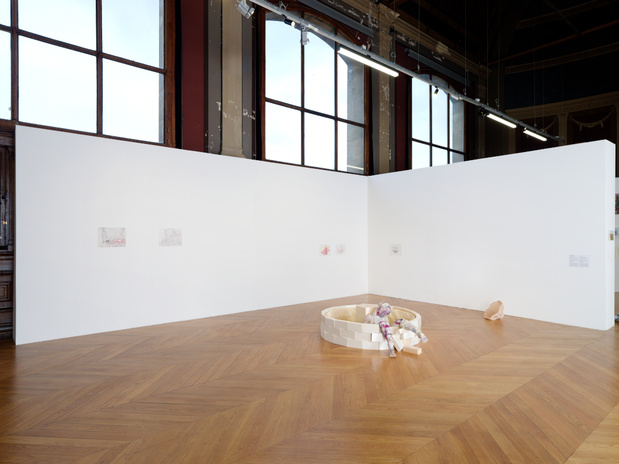
Liselor Perez questions identity as a fragile assemblage through installations and drawings that stage threshold points between architecture and organism. The domestic space, personified, leaves doubt as to whether what we see is a fantasy with a fertile imagination or one trapped by its immediate environment, forcing the body to become, against its will, the support for all those close to it. Existential modification or persistence of trauma, the transformation of flesh and organs always puts into play a body whose freedom remains constantly hindered. G.B.
Caroline Rambaud
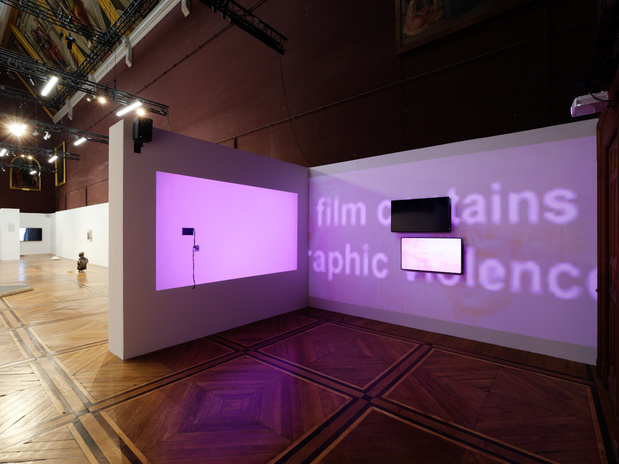
Through frontal confrontation, Caroline Rambaud challenges the viewer by exposing them to an initial sensory violence before opening a space for reconstruction. Dialoguing with anxiety driven cinema and a pop aesthetic that dissolves the image, her installation focuses on the viewing experience and its impact on certain lives.
Rose Ras
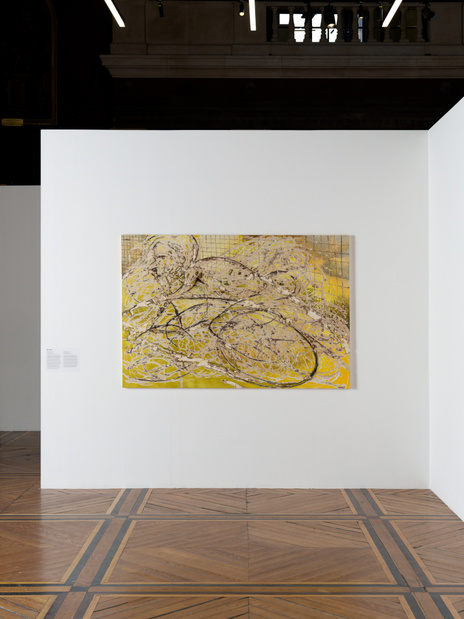
Rose Ras pictorially translates powerful climatic and telluric forces, retranscribing them by perforating wooden panels with a router. Endowed with a circularity that engages the artist’s body, the surface supports an unreal geography of reliefs of which it is nonetheless a reflection. For the artist digs through an initial image the marks of an environment that, while constituting a threat, also forges a link between imaginaries.
Apolline Régent
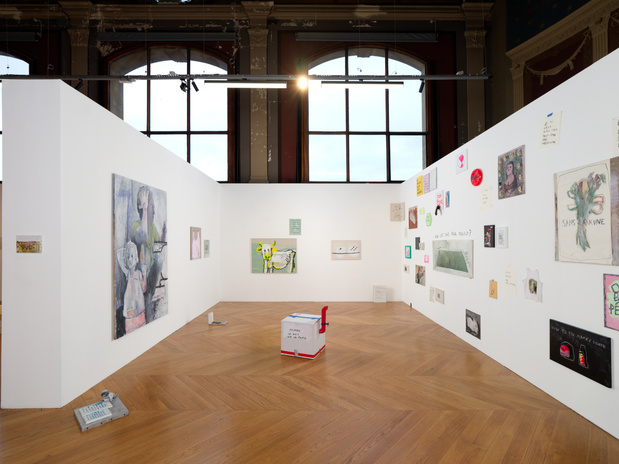
In an explosion of meaning, of senses, of origins and even destinations of her creations, Apolline Régent reactivates a spirit of derision, invention and creative freedom that functions as a chamber of extraordinary transformation of the ordinary. Words, colors, images and matter resonate to the syncopated rhythm of a hanging that speaks to us as much of moments as of a life. Subject to situations and moods, her works throw us into a present diverted by her way of juggling values, supports and the fragilization of the boundaries of gesture. Thus moving from the fantasy of an all powerful expressivity to the staging of its anarchic and ironic covering, the grotesque of this accumulation reveals a beauty in imbalance, perhaps a reflection of our own relationship to the injunctions of beauty. G.B.
Yi Ye
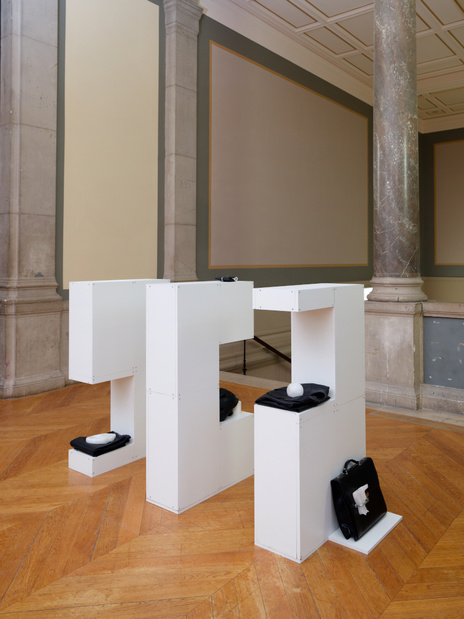
Yi Ye stages the constraints imposed by contemporary spaces, their delimitations and the means of blurring their impossible neutrality. Through unexpected assemblages, he introduces into the contrast of materials and forms an incongruity that plunges the visitor into the heart of an obscure science fiction where graphic codes, stylized, mark a definitive break with their normative uniformity.
Yietnu (Zhang Yi and Ha Nu)
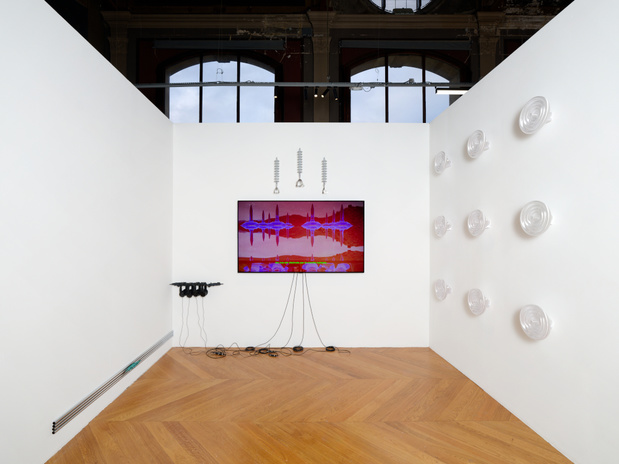
Yietnu, a duo composed of the artists Zhang Yi and Ha Nu, develops fictional narratives to question history, ecology and contemporary transformations. Their immersive installation blends myth and investigation, moving images and fixed objects, blurring temporalities and the message of a thought that explores the concrete threats weighing on our societies.
Felicità 2025, November 26, 2025 — February 1, 2026 — Beaux-Arts de Paris, 13 quai Malaquais, 75006 Paris