Nika Neelova — Nika Project Space, Romainville
With the exhibition Umbra, Nika Project Space offers a compelling immersion into the rich visual vocabulary of Nika Neelova, who, through recovery, transformation, and reinvention, invents a genealogy of perception that imprints and tinges our lives onto the objects around us. Across three distinct series, the object becomes a reflection of emotions and takes on a spirituality and conceptual force that elevate it beyond itself.
Born in Moscow in 1987 and based in London, Nika Neelova shapes a body of work in which architectural remnants become carriers of buried histories. Trained between The Hague and the Slade School, she develops a sculptural practice that repurposes recovered materials and architectural fragments to probe the memory contained within objects. Revealing the human traces inscribed in matter, she brings forth knots of layered temporalities and a sensitive geographical chronology of the places she revives, as in Umbra, whose works continue a line of research undertaken at the Warburg Institute and during a residency at the Sir John Soane’s Museum in London (a major collection of thousands of works from Antiquity to the nineteenth century gathered by the architect). The ensemble furrows the path of a fertile encounter between the chance of a place, what inhabits it, and the diversity of reflections that precede it. In tension, the objects, in their transition to the exhibition, are stripped of their original balance, a constant among the works presented.
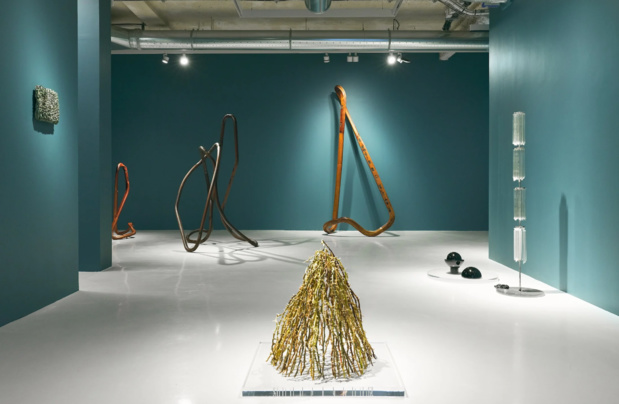
Scattered throughout the space, the objects emerge through a bold scenographic choice, taking on the texture of fleeting memories, associated or disconnected, to convey within the space itself a geography of memory, with its fractured and fragmentary temporality, as well as its propensity for obscurity. Though the elements are heavy (solid wood), blunt (ceramics, shark teeth), and cold (glass, metal), it is fragility that is at stake, an essential threat to matter through its dereliction. Just as their function is diverted, their focus is destined for separation and diffraction. And, like memory, each piece invites us to think of its dissolution rather than its disappearance, of what will endure from them, from it, when they merge with other materials.
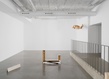
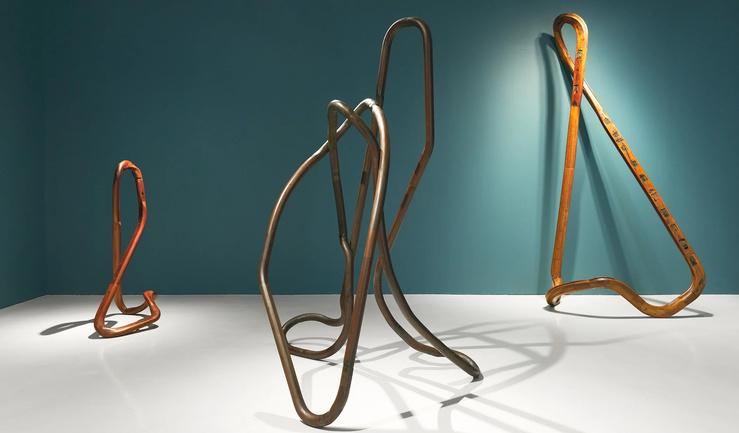
Disassembled handrails, coiled into a multitude of twists, rise in the space, monumental and fragile. Laden even in the veins of their wood with the history of the place and its inhabitants, they become independent creatures, evoking both the sign of infinity and the confined space of the labyrinth. Revealing at times their underside, they also expose irregularities that once served as necessary grips for their original installation, now scars of an obsolete use.
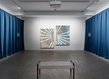
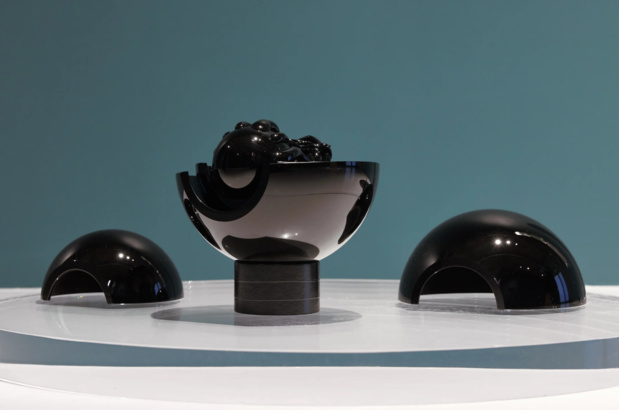
Facing them, a minimalist sculpture restages an anatomical cross-section of the eyeball and reconnects the etymological roots of “seeing” and “glass” to materialize the analogy between knowledge and the evolution of our understanding of the material and the act itself, which share numerous common points, to the extent that one infuses the other, technique redefining the organic ontologically. A screen matching the very color of the glass used, so deeply opaque that nothing of what it contains can be perceived.
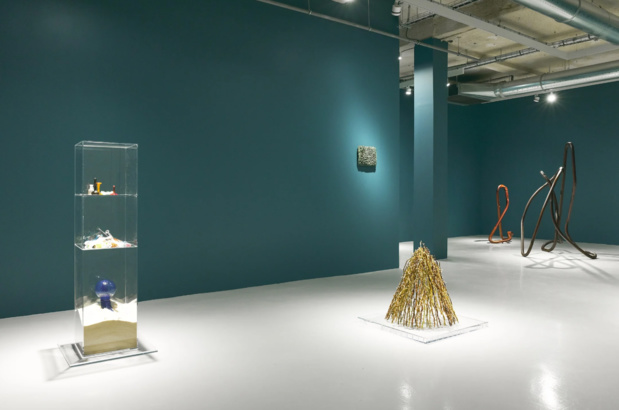
The sculpture Beghost raises its unsettling spines in a fascinating reinterpretation of the Golden Rose, a relic traditionnally offered by the Pope to a sovereign or a place of worship during Lent. Far from this symbol of serenity, stripped of its thorns, Neelova’s dense bouquet beheads the stems of the flower and inserts shark teeth into them, forming a “darting” bush that overturns the famous episode of the theophany. These shark teeth are tied to the symbolic readings they were once given: in ancient Greece, they were thought to be fragments of an eclipse, and in the Middle Ages, petrified dragon tongues. Yet what appeared as fire was only fossilization.
This play of symbolic diversion binds narratives together by extracting parables that, by reversing values, offer unexpected pathways for thought to reinterpret them, anchoring them, like the unsettling points bristling along our path, in a contemporary world inseparable from the questioning of moral tales and legends, yet one in which they nevertheless persist.
A double belief is finally activated with the deeply romantic reinterpretation of the lacrimatories, those small flasks found in ancient tombs that were long believed to hold the tears of the deceased’s loved ones, also echoing Psalm 56:8 in the Bible. Although their function is now questioned, the artist’s reinterpretation, using water-soluble glass for their reproduction (and thus soluble by tears), offers an object of poignant sensitivity, as it gives physical presence to these legends, slowly dissolving over the course of the exhibition, before our eyes, by our eyes.
A subtle blurring of the notions of true and false ultimately connects the spiritual world and tangible reality, allowing the realms of ideas to converse through staging, transformation, and the elaboration of her works. Nika Neelova finds within the thoughts that presided over their conception intimate resonances, juxtaposing the works to highlight, through their differences, the unity of fate that binds them.
From the disappearance of function to biological erosion, everything here hangs beneath a sword of Damocles, and each work seems an attempt to blunt its edge, to prolong that of life.
Nika Neelova, Umbra, From September 14th to December 19th, 2025, Nika Project Space, 43 Rue de la Commune de Paris, 93230, Romainville — Tuesday—Saturday — 10am — 6pm