Rien ne va plus — LAC, Collection Jean-Michel Attal
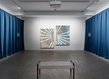
The second exhibition of the Lac, Loukoums & Art Contemporain, Collection Jean-Michel Attal, Rien ne va plus (which means nothing is going right but also nothing goes on the table) asserts not only the strength and coherence of its holdings with a list of artists that is both prestigious and sharp, but also the vigor of the gaze that guides it today in a deliberate intention to engage in a striking and fertile dialogue with history.
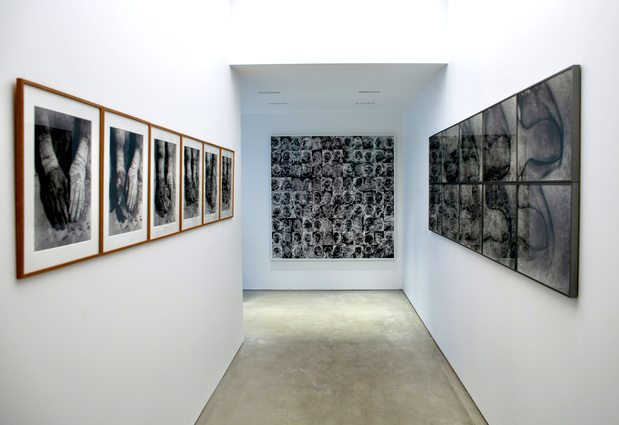
Immersed in a striking corridor and as if strangled by the images of weathered hands, by the fingers held tight between the lips of Dieter Appelt, the visitor steps forward to confront the terrifying extinguished faces of Antoine d’Agata. Life and death dance from the very entrance of this journey, to the syncopated rhythm of the footsteps that carry us from one wall to the next, out of the grip of a radical beauty. Nothing will go right; everything grows taut.
Centered on the polyptych as a medium, the exhibition plays with variation and declension to reveal the scope of polyphonic visions whose multiplied meaning reflects the continuity of disintegration, the pursuit of shock. The ever changing focus prevents synthesis and thus mirrors the constitutive complexity of the world. Nothing is going right because everything accumulates. The spectral threats of works still haunted by the Second World War and the generalized conflicts of the 1990s here demonstrate their terrible relevance by stacking their visionary anxiety onto an era that recreates their seeds.
A paradox that is not one anymore within the blocked horizon of Gregor Schneider and his superb series Totes Haus ur. Venedig. The interior spaces of this paranoid reinvention of his childhood home unfold like so many mental prisons, and the architecture becomes, step by step, the matrix of a labyrinthine race at the heart of an order that crushes us precisely because it is so deeply familiar. As a photographic decaying of his installation within the German Pavilion at the 2001 Venice Biennale, the series reschedules the experience by depriving the body of movement, inscribing into a perpetual duration the absurdity of a structure conceived to drown our hopes, alternating architectural signs to break the security of the home, which behind every door threatens to become a dying room.
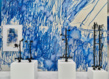
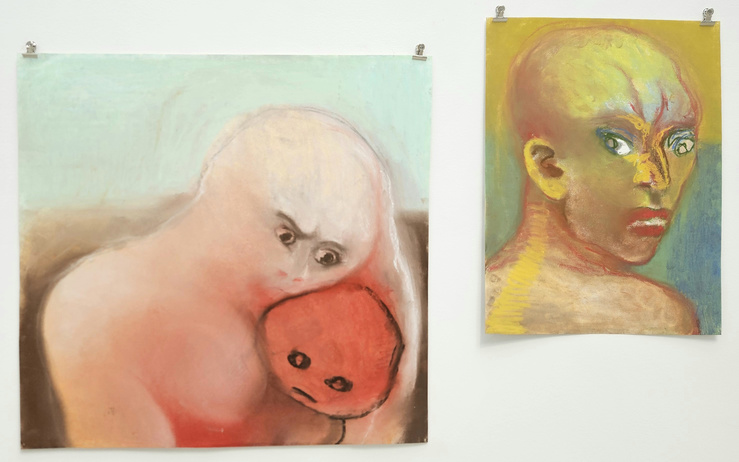
In parallel, when Miriam Cahn seizes the multiple to unfold her series 8 Tage, a group of drawings made in eight days, another fragmentation occurs, that of time, where the urgency of gesture, repetition, approximation and succession define the boundaries of expression. A major work of the exhibition that resonates through the double constraint of time and format imposed on the blazing freedom of her reading of reality, with the grip of divisions in a world that can only be observed from windows, literal and metaphorical.
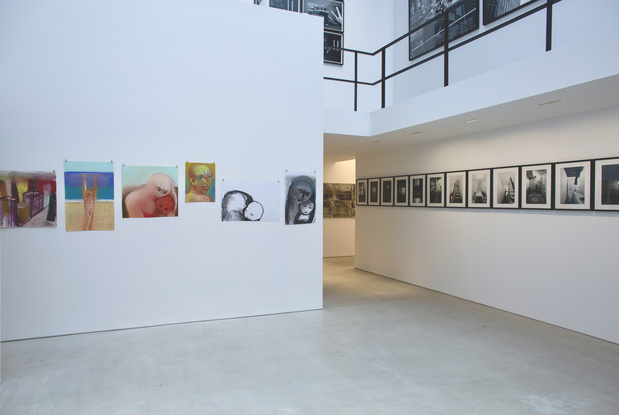
Only perhaps these formulations of limits, these explorations of constraints open a perspective and a possibility, even before emancipating from them, to become aware of the psychological, physical, cognitive and material cells that tighten around our gaze. This same gaze propelled from side to side, from top to bottom, in search of a balance that will seek in vain in these spirited compositions with uneven rhythms. Astonishment repeats itself and dread becomes a constant, making of the medium and even more of its presentation on the walls, nearly accumulated, a crucial knot of its political potency. And the prison freely exposed of Schneider resonates once again. Nothing is going right; everything freezes.
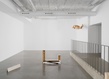
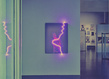
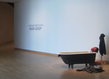
The very structure of the exhibition space thus reveals itself to be a troubling analogy of the journey it hosts, justifying the success of this exhibition and its thematic concerns. Its walkways evoke a form of confinement and surveillance, a carceral feeling that, as a conclusion, will nonetheless allow through elevation a form of sublimation by ascending to the upper floor, where the themes, still as powerful, bring forth the sign through the letter, through form, the word or its absence. From the staging of random objects forming shadows that become the subject of recomposed landscapes by Mac Adams to the reassembled messages of Liam Gillick, from the minute and existential narratives inked onto images whose meaning is weighed down by a circumstantial story in the work of Victor Burgin to the reinvention by Mounir Fatmi of a public intervention in the solitude of a studio, striking the keys of a typewriter made mute under external blows 1, resonance and dissonance become the two faces of a reality grasped only through repeated attempts, the multiplication of proofs of its transformation.
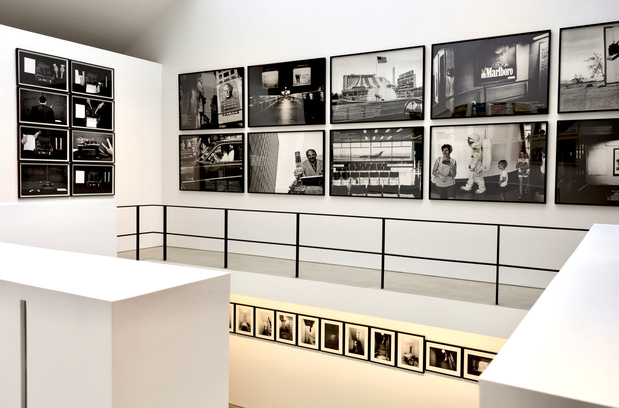
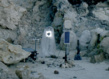
Nothing is going right; everything derails, down to the words, down to language itself. To follow the course of the world, perhaps it is necessary to derail with it. A shift that could almost serve as a conclusion through the series of disappearances A Happy Day by Reynier Leyva Novo, erasing Fidel Castro from a series of photographs, leaving behind an empty lectern and a silent microphone. A strike through history in the form of a snub to the historical falsifications of photographs in communist propaganda. The image of a specter fated to oblivion nonetheless restores the place of a people who continue to form a body and who, though surely full of contradictions, are just as capable of receiving the multiplication of perspectives that, harsh as they may be, resonate with the world they inhabit.
Nothing is going right it is, nothing goes on the table anymore; therefore time to take the injunction seriously, to place our bets and rethink what we assumed to be self evident and perhaps perceive that without multiplying points of view, without fragmenting our own perception, the expected evolution is nothing but a repetition of the cycle.
1 This work is a continuation of the censorship of his work Technologia, which projected verses from the Quran into space. It was removed from the Printemps de Toulouse in 2012 after becoming the site of public demonstrations by Muslim religious groups and the assault of a woman by one of them, who considered it a blasphemy to walk on a floor covered with such luminous signs.
October 9, 2025 to January 10, 2026 — LAC, Loukoums & Contemporary Art, Jean-Michel Attal Collection — 80A, rue Bobillot, 75013 Paris -Free admission — Every Saturday from 2 pm to 5:30 pm