Vincenzo Agnetti — Galerie Tornabuoni Art, Paris
In front of the proliferation of assertions, near the invention of his installations, it might seem paradoxical that Vincenzo Agnetti’s approach should proceed from an act of refusal. Yet it is precisely through rejection that the complex, rich, and all the more sensuous body of work of this major figure of the 1970s in Italy is constructed.
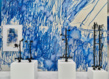
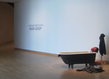
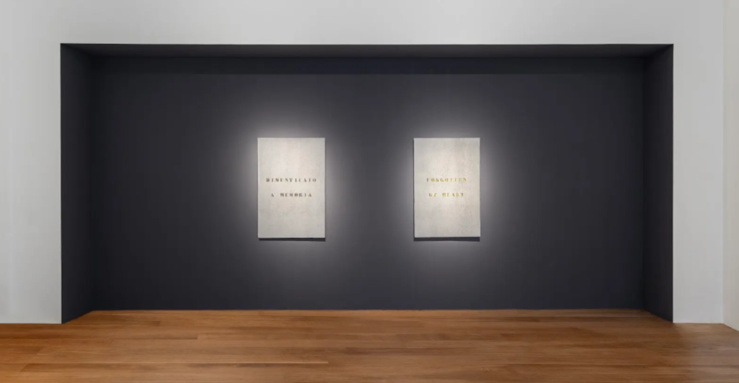
With this exhibition, Tornabuoni Gallery offers a salutary immersion into a seething and striking corpus. Magnetic in the sobriety of their materials and in the dramatization of the primal gesture of writing, the felt canvases presented upstairs and the installations in the basement illustrate with rare pertinence a spirit of contradiction that is anything but a limitation.
A refusal, then, first and foremost, of confinement within tradition. Alongside figures such as Piero Manzoni, Agnetti works within and defends an asserted radicality of the avant-garde, acting as a programmatic critic, poet, and committed artist, seeking to steer the creation of his time toward porous practices in which literature and plastic invention are combined with formal elaboration.
A further refusal follows, within a scene that brings him into contact with major figures of Italian art (he published in Azimuth, the journal founded by Piero Manzoni and Enrico Castellani, alongside Robert Rauschenberg, Lucio Fontana, Jasper Johns…), namely a refusal of the very practice of art itself. Having studied at the Brera Academy of Fine Arts, he leaves the artistic scene and Italy in 1960, an act of absolute radicality that he theorizes, describing it as “liquidationism”.
Above all, this gesture marks a beginning: by allowing all his previous works to disappear, Agnetti opens the way toward a new departure. At the end of the 1960s, he returns to the art world and organizes a solo exhibition, which would of course mark the starting point of a practice nourished by its own void.
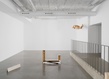
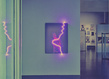
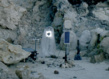
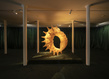
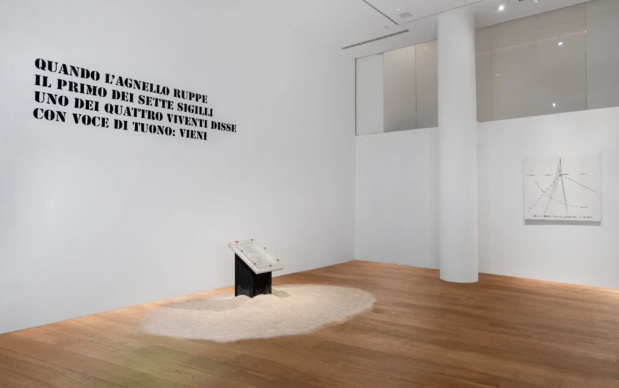
In the gallery’s basement, linguistic inventions multiply, drawing on the plasticity of letters and the spatial support itself to revive myths (The Apocalypse) and the battles of the mind that seek to order them. Science, in turn, becomes a motif; lines and figures accumulate in layers, allowing traces of resistance to oblivion to survive, echoing the marks of phonemes, the oral remnants of rural ways of life abandoned in favor of an urban silence riddled with signs.
“Learning by heart to forget”: this paradigmatic assertion by the artist stands at the heart of the exhibition, which retains its second part, underscoring the ineffably sensitive dimension of an art that reveals itself only in reverse. Above all, it engages, much like this apparent paradox, a forced apprenticeship in loss, an assimilation of productive disappearance, of which one cannot know whether, beyond its pure logic, it conjures or perpetuates the memento mori of vanity.
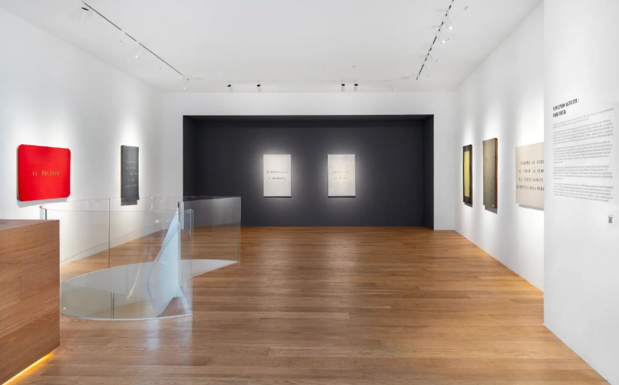
Far from constituting a reduction, the essentialization of text and formula, now turned into motifs in this series that welcomes us, awakens a poetics of the horizon, sustained by the invisible lines bordering the breaking of words that come to be experienced as landscapes composed according to singular orders. Between the rigor of a filled-in window and the constellation of obscure letters escaped into a misty sky of ideas, commands become calls and formulas turn into incantations that bind us. The mark of time, the ineffable poetics of a kindred language, work upon the imagination, projecting us into an era even as they provide the means to escape it.
An appeal to freedom, or rather, a call issued by freedom itself, to lead us to the heart of our own perspectives, which the artist, through his radicality, has the restraint to leave intact, untouched by any imposition. By forbidding himself to mask his idea through image, he makes the image our idea, thus sketching a mirror without reflection of our condition: a wall capable of making us rebound, in order to explore other paths.
Vincenzo Agnetti, Par cœur, Tornabuoni Art, Paris, January 22 to March 28, 2026, 16 ? avenue Matignon, 75008 Paris