Orla Barry — Bétonsalon
Like a reflection of her upended life, Orla Barry’s exhibition Cœur de bergère at Bétonsalon unfolds a constellation of issues and inventions whose narrative thread relies, as in Scheherazade’s tales, on her ability to turn them into a cruel and beautiful story where the lives of sheep and their shepherd intertwine. A title that pays tribute, according to the artist, to the emotional dimension of farming practice. Her artistic gesture seeks precisely to make these muted emotions visible, these deep and often invisible attachments.
At forty, the artist leaves behind the foundations of an traditional artistic practice to take over the family farm. Through her total commitment, through the gaze she casts on this world and the daily involvement she describes, she engages in an artistic approach that fuses with her very existence, from her own body to her means of subsistence. « This work is in ongoing (life) research, as is my life in farming, which I consider as important as my artwork », she says, affirming the indivisibility of her creation and her rural life. By leaving the traditional circuit of contemporary art, she invents a practice that goes beyond the production of artworks to embrace a free and total relationship with a field whose codes she redefines. And even more, through her singular way of conducting and conveying it, she helps us grasp its full scope by abandoning all expectations and any moral stance. Emotion sets the tone and its intensity redefines the standard of pure objectivity of the gaze.

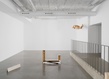
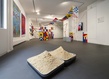
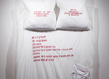
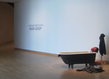
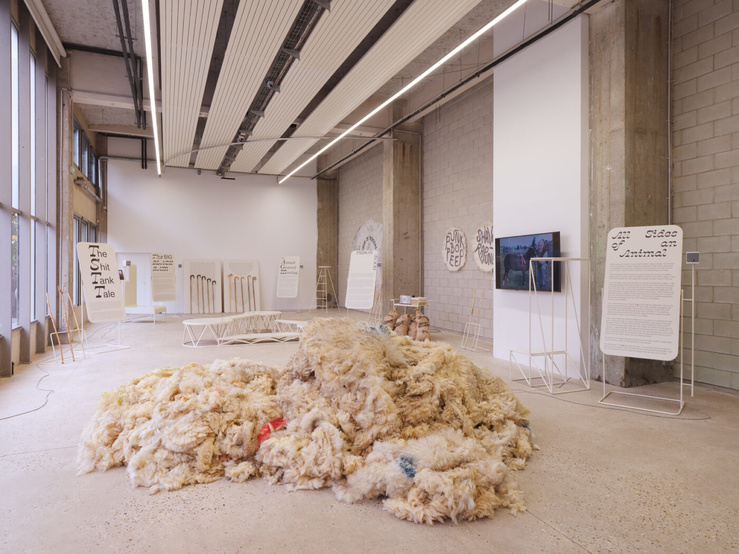
« My artistic life, my life on the farm, my sexual life, everything is blurry, » she says in a documentary about her work. Blurry, because her gaze vibrates through the boundaries. This new life becomes the soil of her production. It sometimes parasitizes it by imposing a constrained rhythm, but always nourishes it by providing the material for fictional or realist narratives whose diversity of narrators and of the thoughts that inhabit them is reflected in the multiplicity of formats. Folding panels, wall prints, pop weavings, tattooed shepherd’s crooks, performances delivered by an actress, as well as thick merchandise bags. Performative work occupies an essential place in her process, engaging the public, its opinions and participation during open rehearsals that helped finalize a performance structuring the exhibition space. The circulation of voices and the porosity between creation and reception extend into the installation. « The artworks are to sit on, and the sound comes from different speakers, so you have to move around the space to hear ». « Fragments of the performance like the Post-its on the text boards, the toast, etc. » remain visible, responding to the artist’s desire that « the performance has space and time; it has a duration ».
In one text, a sheep recounts with sensual exuberance the ritual of its shearing. Elsewhere, Orla Barry shares her doubts and feelings regarding her position as an arbiter within a system where she is both judge and party. Expression becomes a form of resistance in residence. Fiction merges with intimate experience and projects us into the joys and paradoxes of a life of labour governed by fluctuating, sometimes opaque values.
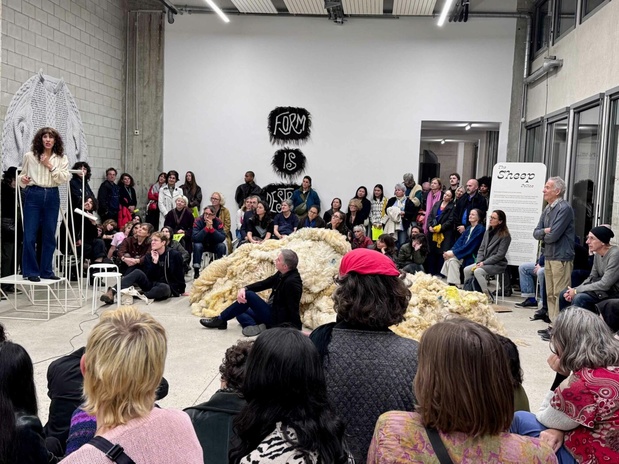
Humour and raw realism, derision and documentary language come together to create a precious testimony with undeniable political force. If her work carries a voice, it conveys above all a position. « Farmers have been vilified in recent years, but it is not the farmers, it is the system. » Behind the shepherdess’s solitude lies a political horizon that emerges in her confrontation with her peers as well as with a society incapable of imagining the reality of a product wool, meat beyond its final value. Barry shifts this age old commercial relationship to reveal the life experience that makes it possible.
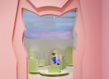
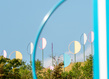
Forms, attempts and experiments accumulate in the space. Behind the elliptical aspect of a fragmented scenography, behind the frontality of an assumed, almost rudimentary arrangement, emerges an exhibition of striking formal accomplishment. The plastic dimension embraces the humility of a creation subjected to the jolts of a life dependent on other beings. Added to this is an economy of means that allocates uses according to the senses and transforms each material wool, horn, fabric, paper, metal into a protagonist of a rebalanced story of relations and values. This logic of hybridisation extends to the circulation of the works themselves. « Somehow, I’m always struggling between exhibiting and performing. Now, for example, I’m looking at ways of how I can rehearse and develop work in the countryside rather than always coming to the city. Later, of course, the work can be shown in the city. Some artworks have toured, both as exhibitions and as performances in theatre spaces. This crossover aspect of my work is very important. »

In this research full of humour, where the artist embraces her self centredness while affirming an horizontality among all the beings that populate her world including animals that belong to her only through mutual adoption discoveries occur through successive shifts. Episodic, eruptive, the strong ideas gather in a coherence of resistance and the need for invention. Orla Barry thus becomes a world by herself (a « personnage-monde ») who overturns the romantic vision, both that of the shepherdess Bo Peep and that of the bohemian figure, to crystallize a place of reinvented sentimentality. Her pastoral prose then turns into a poetics of the living, attentive to the imbalances between species as much as to those within them.
« I feel an ovine teardrop, » she concludes in a text evoking the economic obsolescence of a practice that once united sheep and shepherd, the shearing of wool that could compensate the one who collected it and ensured the animals’ life on the pasture. Cœur de bergère thus gives the pulse of someone capable of beating in rhythm with her animals, lending her voice and devoting her art to the wordless intimacy that binds them. A bond to which we can now all hold on.
Orla Barry, Cœur de bergère, from October 18 to December 20 2025 — Bétonsalon, 9 Esplanade Pierre Vidal-Naquet, 75013 Paris — Wednesday to Friday from 11am to 7pm, Saturday from 2pm to 7pm.